
Can IVF Worsen Endometriosis? Hyderabad’s Top IVF Doctor Explains.
Medically reviewed by Dr. Aarti Deenadayal Tolani, Fertility Specialist & IVF Expert, Mamata Fertility Hospital, Hyderabad
IVF does not permanently worsen endometriosis. The ovarian stimulation injections temporarily raise oestrogen levels, which can cause a short-term increase in pelvic discomfort and endometrioma size during the stimulation phase. Once the cycle ends, oestrogen returns to baseline and these effects resolve. Long-term research does not show that IVF causes endometriosis to progress. With the right protocol often a GnRH agonist down-regulation or freeze-all strategy IVF is both safe and effective for women with endometriosis.
If you have been told you have endometriosis and are considering IVF, the fear that treatment will make things worse is understandable and common.
This article explains exactly what happens to endometriosis during an IVF cycle, what risks are real, which ones are not, and how an experienced fertility team tailors the protocol to protect you.
What Is Endometriosis and Why Does It Complicate IVF?
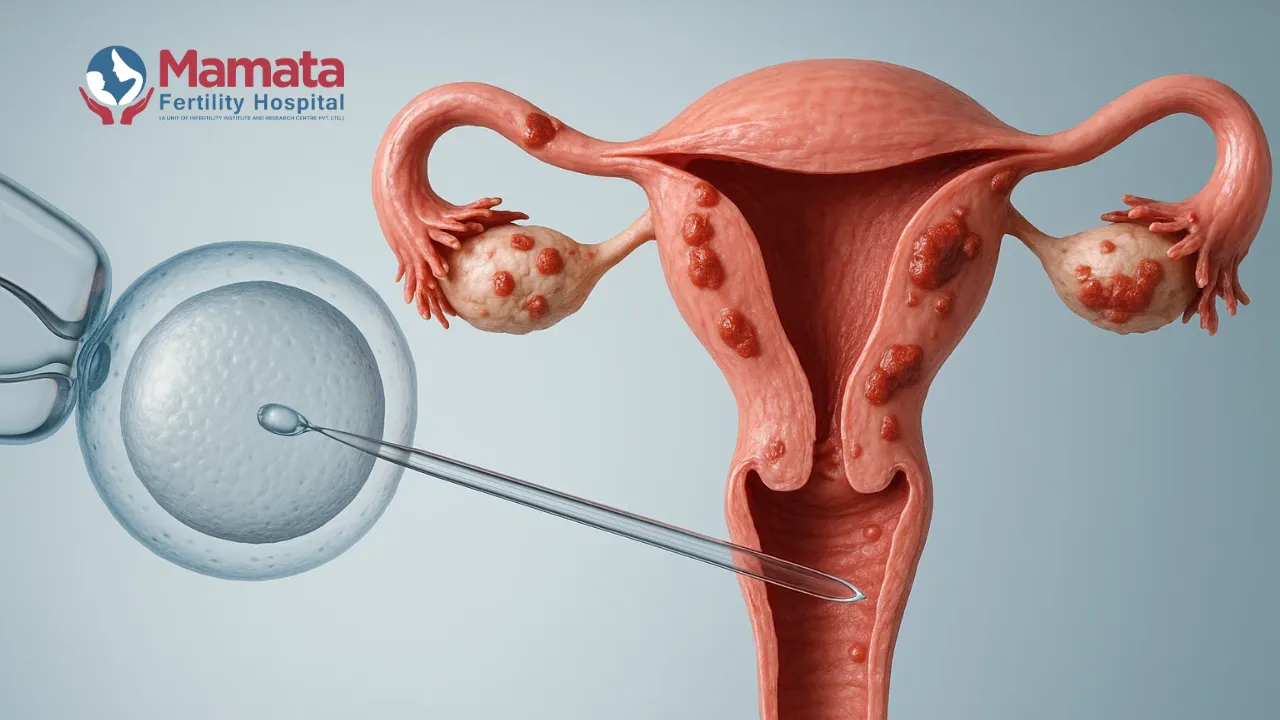
Endometriosis is a condition in which tissue similar to the uterine lining (endometrium) grows outside the uterus on the ovaries, fallopian tubes, pelvic lining, or other pelvic structures. This misplaced tissue responds to oestrogen: it thickens, breaks down, and bleeds with every menstrual cycle, causing inflammation, scar tissue, and sometimes cysts on the ovaries called endometriomas (also known as chocolate cysts).
Oestrogen drives endometriosis. And IVF stimulation drugs raise oestrogen significantly. This is the core of the concern and the core of what needs to be carefully managed.
To understand how endometriosis affects your fertility, including how it interferes with egg quality, fallopian tube function, and implantation, read our detailed guide. The symptoms of endometriosis painful periods, pelvic pain, pain during intercourse, and irregular bleeding can also intensify temporarily during the stimulation phase of IVF.
What Happens to Endometriosis During an IVF Cycle?
To understand the risk, it helps to go stage by stage through the IVF cycle.
Stage 1: Ovarian Stimulation (Days 1–12)
During stimulation, you give yourself daily FSH (follicle-stimulating hormone) injections to encourage the ovaries to produce multiple follicles. As follicles grow, they produce large amounts of oestrogen — levels that are significantly higher than a natural cycle.
What this means for endometriosis:
- High oestrogen temporarily stimulates endometriotic tissue
- Existing endometriomas (ovarian cysts) may increase slightly in size during stimulation
- Pelvic bloating and discomfort may be more pronounced than usual
- Women with pre-existing pelvic pain may notice heightened sensitivity during the final days before egg retrieval
This is real but it is temporary. When stimulation ends and egg retrieval is performed, oestrogen levels fall sharply. Symptoms that worsened during stimulation generally settle within days.
Does stimulation permanently grow endometriosis?
Current evidence says no. Studies do not show that one or more IVF cycles cause endometriosis to progress in a clinically significant way. The temporary hormonal environment is short-lived and does not alter the underlying disease course.
Stage 2: Egg Retrieval and Endometriomas
This is the stage that carries the most specific risk for women with endometriosis.
If you have an endometrioma a blood-filled cyst on one or both ovaries — the egg retrieval needle will pass near or through the cyst wall to reach the follicles beneath. This creates two specific risks:
Risk 1: Cyst infection. Puncturing an endometrioma during retrieval can introduce bacteria, causing a post-retrieval pelvic infection. This is uncommon (occurring in less than 1% of cases in experienced hands) but serious if it happens. Your team will assess endometrioma size and location before retrieval and may prescribe prophylactic antibiotics.
Risk 2: Ovarian reserve damage. Endometriomas are surrounded by ovarian cortex that contains follicles (eggs). Both the cyst itself and any treatment to remove it can reduce the number of functional follicles remaining. Surgical removal of an endometrioma before IVF reduces retrieval-related risks — but surgery also carries its own risk to ovarian reserve. This trade-off is one of the most nuanced decisions in endometriosis-related IVF planning.
Most specialists use a size threshold of approximately 4 centimetres: endometriomas smaller than this are usually monitored rather than operated on before IVF. Larger endometriomas may require surgical assessment first, particularly if they are growing, causing significant symptoms, or likely to obstruct access to the follicles. Understanding the difference between endometriosis and an ovarian cyst can help you ask the right questions at your consultation.
For women who have already had endometriosis surgery and are concerned about recurrence, whether endometriosis comes back after surgery is a separate consideration that your fertility team will factor into timing decisions.
How Fertility Specialists Modify IVF Protocols for Endometriosis?
IVF for women with endometriosis is not one-size-fits-all. Here are the main protocol adjustments an experienced team will consider:
1. GnRH Agonist Down-Regulation (Long Protocol)
GnRH agonists — such as Lupride (Leuprolide) or Buserelin — suppress the pituitary gland, which in turn suppresses oestrogen production. This is used as a “pre-treatment” phase before stimulation begins.
Why this matters for endometriosis: suppressing oestrogen for 4–8 weeks before starting IVF:
- Quietens active endometriotic lesions temporarily
- Reduces inflammation in the pelvic environment
- May improve endometrial receptivity (the uterine lining’s ability to accept an embryo)
- Some studies show 3–6 months of GnRH agonist down-regulation before IVF significantly improves pregnancy rates in women with endometriosis — particularly Stages III and IV
The role of Lupron and Lupride injections in IVF is covered in detail in our dedicated guide. For endometriosis patients, this is one of the most valuable tools in the IVF preparation toolkit.
2. Freeze-All Strategy (Cryopreservation Cycle)
In a standard IVF cycle, the best embryo is transferred to the uterus in the same cycle as egg retrieval (a “fresh transfer”). For women with endometriosis, this is often not the best approach.
Here is why: the high oestrogen environment during stimulation can affect endometrial receptivity, making the uterine lining less responsive to implantation. A fresh transfer means placing the embryo into this hormonally stimulated environment which may reduce success rates.
A freeze-all strategy means:
- All usable embryos are frozen (vitrified) at the blastocyst stage after retrieval
- No embryo transfer happens in the stimulation cycle
- In a subsequent natural or medicated cycle, one embryo is thawed and transferred in a calmer hormonal environment
- This gives the uterine lining time to return to its natural state
The comparison between frozen and fresh embryo transfer explains this in detail. For endometriosis patients, a frozen embryo transfer (FET) cycle often gives better results than a fresh transfer.
3. ERA Testing (Endometrial Receptivity Array)
Endometriosis can shift the implantation window the narrow period during which the uterine lining is most receptive to an embryo. In some women with endometriosis, this window is displaced by one or two days from the expected timing.
ERA (Endometrial Receptivity Array) is a biopsy-based test that identifies the exact optimal day for embryo transfer based on the individual uterus. For women with endometriosis who have experienced failed transfers, ERA can reveal whether the timing of transfer needs adjustment.
If you want to increase endometrial thickness for IVF alongside ERA testing, both can be part of a pre-transfer preparation plan.
4. Addressing Egg Quality
Endometriosis creates a pro-inflammatory pelvic environment, and oxidative stress from this inflammation can affect the quality of eggs at the time of retrieval. Women with endometriosis particularly those with Stage III or IV disease, may retrieve fewer mature eggs and have a higher rate of poor-quality embryos compared to women without endometriosis.
Strategies to support egg quality include:
- Antioxidant supplementation in the weeks before stimulation (as recommended by your doctor)
- Optimising the stimulation protocol based on your AMH and antral follicle count
- PGT-A (Preimplantation Genetic Testing for Aneuploidies) chromosomal testing of embryos before transfer, which selects the most viable embryos and may reduce miscarriage risk
For more on this, Read: how to improve egg quality for IVF success.
5. Laparoscopy Before IVF — When and Whether to Operate
Not all women with endometriosis need surgery before IVF. The decision depends on:
- Size and location of endometriomas: Cysts smaller than 4cm with good ovarian reserve on the affected side are usually watched rather than operated on before IVF
- Severity of endometriosis: Stages I and II endometriosis rarely require surgery before IVF. Stages III and IV are evaluated case by case
- Symptom severity: If active pain and inflammation are affecting daily life, surgical management may both improve quality of life and the IVF environment
- Previous surgery: Repeated ovarian surgery carries compounding risk to ovarian reserve — each operation reduces the functional follicle pool
- Blocked fallopian tubes: Surgery to treat tubal damage from endometriosis is sometimes considered, but IVF bypasses the tubes entirely, so this is not always necessary
Laparoscopy for endometriosis — costs and recovery gives a practical overview for women weighing this decision. When to do endometriosis surgery covers the clinical thresholds in more detail.
IVF With Endometriosis: What the Research Says
A concern many patients bring to their first consultation is: “Will IVF make my endometriosis so bad that I cannot have another cycle if the first one fails?”
The evidence is reassuring. Multiple studies, including long-term follow-up data, do not show that IVF causes endometriosis to worsen in a clinically significant or lasting way. The temporary hormonal spike during stimulation does not alter the stage or extent of the disease. Women who have undergone multiple IVF cycles do not show accelerated disease progression compared to those who have not.
What IVF does not do:
- It does not create new endometriosis lesions
- It does not cause Stage I endometriosis to progress to Stage IV
- It does not increase the risk of endometriosis-related complications such as endometriomas rupturing (though retrieval near an endometrioma carries a small risk, as described above)
What IVF can do with proper management:
- Achieve pregnancy in women with all stages of endometriosis
- Improve outcomes significantly when the right protocol is used (GnRH agonist pre-treatment, freeze-all, ERA)
- Give women with severely distorted pelvic anatomy — blocked tubes, dense adhesions — their best realistic path to pregnancy
For women who are concerned about whether pregnancy improves or worsens endometriosis, the short answer is that pregnancy itself through the suppression of menstruation tends to temporarily quieten the condition. IVF leading to a successful pregnancy therefore does not worsen endometriosis in the long term.
IVF With Endometriosis: What the Research Says
A concern many patients bring to their first consultation is: “Will IVF make my endometriosis so bad that I cannot have another cycle if the first one fails?”
The evidence is reassuring. Multiple studies, including long-term follow-up data, do not show that IVF causes endometriosis to worsen in a clinically significant or lasting way. The temporary hormonal spike during stimulation does not alter the stage or extent of the disease. Women who have undergone multiple IVF cycles do not show accelerated disease progression compared to those who have not.
What IVF does not do:
- It does not create new endometriosis lesions
- It does not cause Stage I endometriosis to progress to Stage IV
- It does not increase the risk of endometriosis-related complications such as endometriomas rupturing (though retrieval near an endometrioma carries a small risk, as described above)
What IVF can do with proper management:
- Achieve pregnancy in women with all stages of endometriosis
- Improve outcomes significantly when the right protocol is used (GnRH agonist pre-treatment, freeze-all, ERA)
- Give women with severely distorted pelvic anatomy — blocked tubes, dense adhesions — their best realistic path to pregnancy
For women who are concerned about whether pregnancy improves or worsens endometriosis, the short answer is that pregnancy itself — through the suppression of menstruation — tends to temporarily quieten the condition. IVF leading to a successful pregnancy therefore does not worsen endometriosis in the long term.
Should You Try Surgery or IVF First?
This depends on your specific situation. Here is a general clinical framework:
| Situation | Typical Recommendation |
|---|---|
| Mild endometriosis (Stage I–II), no endometrioma, tubes open | Proceed to IVF; surgery unlikely to improve IVF outcomes |
| Endometrioma <4 cm, good ovarian reserve | IVF with careful monitoring; avoid surgery to protect reserve |
| Endometrioma >4 cm or growing rapidly | Surgical assessment before IVF; risk-benefit discussion with specialist |
| Severe endometriosis (Stage III–IV), distorted anatomy | GnRH agonist pre-treatment + IVF often preferred over extensive surgery |
| Failed IVF with suspected endometrial receptivity issue | ERA testing + frozen embryo transfer |
| Suspected adenomyosis alongside endometriosis | Requires separate evaluation; endometriosis and adenomyosis together is a distinct clinical picture |
If you have had 3 or more failed IVF cycles and have endometriosis, a full investigation, including ERA, immunological panel, and endometriosis-specific protocol review is essential before the next attempt. A second opinion for IVF failure is reasonable and often leads to a different approach.
Endometriosis Stages and IVF Success
Endometriosis is staged from I (minimal) to IV (severe) based on the extent and location of lesions. Stage does not map perfectly onto fertility outcomes or IVF success rates, women with Stage IV endometriosis can and do have successful IVF pregnancies.
However, higher stages are associated with:
- Lower egg yield per retrieval (fewer follicles, due to ovarian damage)
- More variability in egg quality
- Greater benefit from pre-treatment with GnRH agonists
- Higher likelihood of needing a freeze-all strategy due to endometrial factors
Women with Stage 4 endometriosis often ask whether IVF is even possible. It is but success rates are typically lower than in women without endometriosis, and the protocol requires more careful tailoring. Realistic expectations and a specialist team experienced in severe endometriosis are both essential.
The Difference Between Endometriosis and Adenomyosis in IVF
Some women have both endometriosis and adenomyosis — a related condition where endometrial-like tissue grows within the muscular wall of the uterus itself. Adenomyosis affects implantation and carries different considerations for IVF.
If your ultrasound or MRI shows features of adenomyosis alongside endometriosis, your IVF protocol may need to address both. The difference between endometriosis and adenomyosis and how each affects IVF outcomes — is important to discuss with your fertility specialist.
Lifestyle Support During IVF With Endometriosis
While your medical team manages the protocol, there are things you can do to support your body during the process:
Diet: An anti-inflammatory diet is often recommended for women with endometriosis undergoing IVF. This means reducing red meat, processed foods, and refined sugars, and increasing omega-3 rich foods, vegetables, and antioxidant-rich fruits. Read our dietary guide for women with endometriosis for specific guidance.
Weight management: Both obesity and very low body weight can affect IVF outcomes. For women with endometriosis, maintaining a healthy BMI reduces systemic inflammation. How weight affects fertility applies to endometriosis patients as much as any other group.
Stress management: The effect of stress on fertility is real and relevant during IVF treatment. Women with endometriosis often carry the additional emotional burden of a chronic, painful condition — support services, including counselling, can make a meaningful difference.
IVF and Endometriosis at Mamata Fertility Hospital, Hyderabad
At Mamata Fertility Hospital, women with endometriosis receive individually designed IVF protocols — not a standard approach applied to every patient. Before recommending treatment, we assess:
- Ovarian reserve (AMH, antral follicle count) to understand the impact of existing endometriosis on egg supply
- Endometrioma size and location via transvaginal ultrasound
- Uterine structure and any associated adenomyosis
- Previous surgical history and its impact on current reserve
- Stage of endometriosis and symptom profile
Based on this, we determine whether GnRH agonist pre-treatment, a freeze-all strategy, ERA testing, or laparoscopic intervention is appropriate before starting stimulation.
For women with PCOS and endometriosis together a combination that requires balancing OHSS risk alongside endometriosis management our team has specific experience in protocol design.
IVF treatment in Hyderabad at our ICMR-registered facility is supported by advanced embryology, genetic testing, and endocrinology expertise. Whether you are starting IVF for the first time or coming to us after previous failures elsewhere, your consultation begins with a complete picture of your situation not assumptions.
Want to understand what to expect during your first fertility consultation with our team? Read our guide.
Frequently Asked Questions
Does IVF make endometriosis permanently worse?
No. Current evidence does not show that IVF causes endometriosis to progress in a lasting way. The stimulation phase temporarily raises oestrogen, which can increase symptoms short-term, but these effects resolve after the cycle ends.
Can I do IVF if I have an endometrioma?
Yes, in most cases. Endometriomas smaller than approximately 4cm can usually be monitored during IVF rather than removed. Larger endometriomas, or those that block access to follicles, may require surgical assessment first. Your specialist will advise based on size, location, and ovarian reserve.
Will the IVF hormones cause my endometriosis to spread?
No. IVF stimulation hormones do not create new endometriosis lesions or cause existing lesions to spread to new locations. The temporary oestrogen rise during stimulation is short-lived and does not alter the course of the disease.
Does endometriosis reduce IVF success rates?
It can, particularly with higher-stage endometriosis. Egg yield may be lower and egg quality more variable. However, with a protocol tailored to endometriosis — GnRH agonist pre-treatment, freeze-all, ERA many women with endometriosis achieve successful IVF pregnancies.
Should I have surgery before IVF for endometriosis?
Not always. This depends on the size of any endometriomas, your ovarian reserve, the stage of endometriosis, and your symptoms. Mild-to-moderate endometriosis without large cysts often does not need surgery before IVF. Your fertility specialist will advise after assessing your individual situation.
What protocol is best for IVF with endometriosis?
Many endometriosis patients benefit from a GnRH agonist long protocol, a freeze-all strategy with frozen embryo transfer, and ERA testing if there is a history of failed transfers. The right protocol depends on your stage of endometriosis, ovarian reserve, and prior treatment history.
Can IVF help women with severe (Stage IV) endometriosis?
Yes. IVF is often the best — sometimes the only realistic — path to pregnancy for women with severe endometriosis, particularly those with blocked tubes or extensive pelvic adhesions that prevent natural conception. Success rates are lower than in women without endometriosis, but many women with Stage IV disease have successful IVF pregnancies.
What is the cost of IVF with endometriosis in Hyderabad?
The cost depends on the protocol used. A cycle with GnRH agonist pre-treatment, freeze-all, and ERA involves more steps than a standard IVF cycle. Read our IVF cost guide for Hyderabad for a detailed breakdown, or speak to our team for a personalised estimate.
IVF Does Not Worsen Endometriosis — But Endometriosis Does Require a Different Kind of IVF?
The fear that IVF will make endometriosis worse is understandable. Oestrogen drives the condition, and IVF raises oestrogen. But the temporary hormonal changes of a stimulation cycle do not permanently worsen endometriosis and long-term evidence supports this clearly.
What endometriosis does require is an IVF team that understands it. The standard protocol that works for most patients is not always the right protocol for someone with endometriomas, pelvic inflammation, or adenomyosis. The difference between a protocol that is merely acceptable and one that is genuinely optimised for your situation can meaningfully change your chances of success.
If you have endometriosis and are considering IVF, start with a consultation where your doctor spends time on your specific picture not a template. Ask about GnRH agonist pre-treatment, the freeze-all strategy, ERA testing, and how they plan to manage any endometriomas. These are not optional extras for many women with endometriosis, they are the difference between a cycle that works and one that does not.
Endometriosis and IVF: Get a Protocol Designed for Your Situation
Women with endometriosis deserve more than a standard IVF cycle. At Mamata Fertility Hospital Hyderabad, your consultation includes a complete assessment of how endometriosis is affecting your fertility — and a protocol designed around that picture.
Our team will advise you on:
✅ Whether surgery is needed before IVF — or whether to proceed directly
✅ GnRH agonist pre-treatment to quieten endometriosis before stimulation
✅ Freeze-all and frozen embryo transfer strategy
✅ ERA testing if previous transfers have failed
✅ Endometrioma management during retrieval
✅ Egg quality support for endometriosis-related ovarian impact
Book a Fertility Consultation Today

Dr Aarti Deenadayal Tolani
MBBS, MS ( OBGYN), FICOG
Clinical Director, Scientific In- Charge & Fertility Consultant with 20+ years Of Experience
Her Expertise:
CONSULT FERTILITY SPECIALIST

Latest Blogs

How to Read and Interpret a Semen Analysis Test Report?
Learn how to read and interpret a semen analysis report, including sperm count, motility, morphology, semen volume, vitality, Total Motile Count, and WHO 2021 reference values.

How to Choose an IVF Clinic: A Patient’s Checklist
Choosing an IVF clinic? Use this patient checklist to compare diagnosis, ART registration, success rates, costs, treatment teams, add-ons and support.

Understanding Sperm DNA Fragmentation Test and IVF Success
Understand sperm DNA fragmentation testing, DFI levels, causes of high sperm DNA damage, and how SDF can affect IVF, ICSI, embryo quality and miscarriage risk.

Oligospermia Treatment: Low Sperm Count & Pregnancy Options
Oligospermia means a low sperm count. Learn its causes, diagnosis, treatment options, IUI, IVF with ICSI, and chances of conception.
