

Frozen Embryo Transfer vs Fresh Transfer: Which Has Better Success?
Welcome. I am Dr Mamata Deenadayal. Over my decades of practice as a fertility specialist at Mamata Fertility Hospital, Hyderabad, I have held the hands of countless couples navigating the emotional labyrinth of IVF. When you are pouring your heart, soul, and resources into building a family, every medical decision feels immense.
One of the most common questions I hear in my consultation room is: “Doctor, should we do a frozen embryo transfer or a fresh transfer?” Couples often come to me feeling confused and anxious, having read conflicting advice online about which method offers better embryo transfer success.
Please take a deep breath. You do not have to make this decision alone, and there is no single “correct” answer for everyone. Both frozen and fresh transfers have distinct benefits depending entirely on your unique biological condition. In this comprehensive guide, I will walk you through the differences between frozen embryo transfer vs fresh transfer, how we make this critical decision together, and what you can realistically expect from your IVF journey.
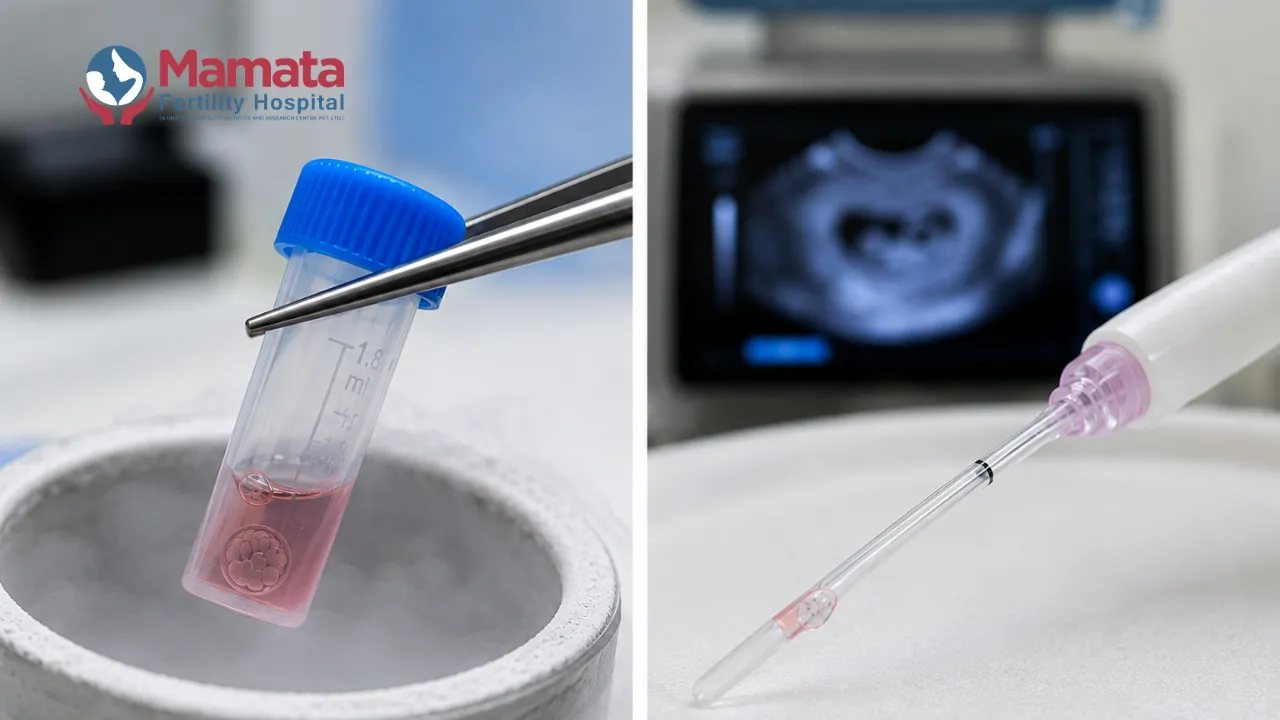
What Is Embryo Transfer in IVF?
To understand the difference between fresh and frozen transfers, we first need to understand the role of the embryo transfer itself.
In Vitro Fertilisation (IVF) is a multi-step process. First, we stimulate your ovaries to produce multiple eggs. We then gently retrieve these eggs and fertilise them with your partner’s sperm in our secure embryology laboratory. Over the next three to five days, these fertilised eggs grow and divide, becoming embryos.
The embryo transfer is the final, beautiful step of the IVF process. Using a very thin, soft catheter, I carefully place the best-quality embryo directly into your uterus, with the hope that it will implant and grow into a healthy baby.
The decision we must make is when to do this transfer. Do we transfer the embryo immediately in the same cycle (a fresh transfer), or do we freeze the embryo and transfer it in a later cycle (a frozen transfer)?
What Is Fresh Embryo Transfer?
A fresh embryo transfer takes place during the exact same menstrual cycle as your egg retrieval.
Here is how the timeline typically works: After you take the stimulation medications and we retrieve your eggs, the embryologist fertilises them. Three to five days later, while your ovaries are still enlarged from the stimulation and your hormone levels are highly elevated, we select the best-growing embryo and transfer it directly into your uterus.
For many years, fresh transfers were the standard protocol for all IVF cycles because early freezing technology was not as reliable as it is today. Fresh transfers are still commonly recommended for patients who have an ideal, natural response to IVF medications and whose uterine lining looks perfectly receptive immediately after retrieval.
Do You Need a Doctor Consultation
What Is Frozen Embryo Transfer (FET)?
A Frozen Embryo Transfer (FET) separates the creation of the embryo from the actual transfer.
In this scenario, after your eggs are retrieved and fertilised, we use an advanced, rapid-freezing technique called vitrification to safely freeze all your high-quality embryos. We do not perform a transfer in that same cycle. Instead, we let your body rest. We allow your ovaries to recover from the stimulation medications and your hormone levels to return to their natural baseline.
Weeks, months, or even years later, when your body is fully rested and your uterine lining is perfectly prepared, we carefully thaw one embryo and transfer it. FET offers immense flexibility in treatment planning and has revolutionised modern IVF treatment options.
Need Personalised Guidance?
Choosing between a fresh or frozen transfer depends on your unique health profile. Book a consultation at Mamata Fertility Hospital, Hyderabad today to get a customised IVF treatment plan designed specifically for you.
Frozen vs Fresh Embryo Transfer: Key Differences
To help you visualise the differences clearly, I have created this simple comparison table.
|
Factor |
Fresh Embryo Transfer |
Frozen Embryo Transfer (FET) |
|
Timing |
Transferred 3 to 5 days after egg retrieval. |
Transferred in a completely different, later cycle. |
|
Uterine Preparation |
Immediate. The lining is influenced by high levels of stimulation hormones. |
Optimised. We can carefully control and perfectly time the lining preparation. |
|
Hormonal Impact |
Higher. The body is still recovering from egg retrieval medications. |
Controlled. The body has rested, and hormone levels are stable. |
|
Flexibility |
Limited. The transfer must happen on a specific day. |
More flexible. You choose the month that suits your body and schedule. |
|
Success Rates |
Varies. Excellent for specific candidates, lower for others. |
Often comparable or higher, especially for women with high hormone levels. |
Which Has Better Success Rates?
When couples ask me about fresh embryo transfer success rate versus frozen embryo transfer success rate, they are looking for a definitive winner. However, the medical truth is that success depends heavily on the individual patient.
Success relies on three main pillars: your age, the quality of the embryo, and the health of your uterine environment.
Historically, fresh transfers were thought to be better. But today, thanks to the perfection of vitrification (rapid freezing), frozen embryos have the exact same survival and implantation potential as fresh ones. In fact, many recent clinical studies show that FET can have equal, and sometimes even higher, success rates for certain women.
Why? Because the high doses of hormones required to stimulate your ovaries can sometimes prematurely age the lining of your uterus, making it less receptive to an implanting embryo. By freezing the embryo and waiting for a subsequent cycle (FET), we can create a much more natural and welcoming environment in the womb. I always advise my patients to focus on what is best for their specific biology, rather than general internet statistics.
When Do Doctors Recommend a Fresh Transfer?
Despite the rise in frozen transfers, a fresh transfer is still an excellent choice for many women. I typically recommend a fresh embryo transfer when:
- You Have a Moderate Response to Stimulation: If you produce a healthy, but not excessive, number of eggs, your hormone levels remain relatively balanced.
- Your Uterine Lining Looks Perfect: If ultrasound scans show your endometrium is thick, trilaminar (three-layered), and perfectly receptive just days after retrieval, a fresh transfer is a great option.
- There Is No Risk of OHSS: Ovarian Hyperstimulation Syndrome (OHSS) is a condition where the ovaries become painfully swollen. If your risk is low, we can proceed safely with a fresh transfer.
- You Prefer a Shorter Timeline: A fresh transfer completes the IVF cycle more quickly, which some couples prefer for emotional or logistical reasons.
When Is Frozen Embryo Transfer Preferred?
In modern fertility care, we are increasingly moving towards “freeze-all” cycles. I strongly prefer and recommend a Frozen Embryo Transfer in the following situations:
- High Risk of OHSS: If you have Polycystic Ovary Syndrome (PCOS) or produce a very high number of eggs, your oestrogen levels will be extremely high. Doing a fresh transfer can trigger or worsen OHSS. Freezing the embryos is the safest medical choice.
- Hormonal Imbalance: If your progesterone levels rise too early before egg retrieval, it signals that the uterine lining is out of sync with the embryo. An FET allows us to correct this timing.
- Need for Genetic Testing (PGT): If you require Preimplantation Genetic Testing to screen embryos for chromosomal abnormalities, the embryos must be frozen while we wait for the laboratory results.
- Better Uterine Preparation: If your lining is too thin during the fresh cycle, freezing the embryos allows us to use specific medications in a later cycle to perfectly thicken and prepare your uterus.
Factors That Affect IVF Success
Whether we choose a fresh or frozen transfer, several universal factors dictate overall IVF success rates.
- Age of the Patient: The female partner’s age is the most critical factor. As women age, the genetic quality of their eggs naturally declines, which directly impacts embryo quality.
- Embryo Quality: A strong, chromosomally normal embryo is essential for implantation. Our advanced embryology lab plays a massive role in culturing robust embryos.
- Uterine Health: The uterus must be free of polyps, fibroids, and scar tissue. A healthy, thick endometrium is the fertile soil where the embryo will take root.
- Lifestyle Factors: Maintaining a healthy body weight, managing stress, eating a nutrient-dense diet, and avoiding smoking and excess alcohol dramatically improve your chances of success.
What to Expect During Each Process?
Understanding the physical steps of each journey helps alleviate anxiety.
The Fresh Transfer Journey:
You will undergo daily injections to stimulate egg growth. After the egg retrieval surgery, you will start taking progesterone supplements. Three to five days later, you will return to the clinic. You will need a full bladder. I will gently insert a catheter through your cervix and place the embryo into your uterus. You will then wait about 12 to 14 days for your pregnancy blood test.
The Frozen Transfer Journey:
Your egg retrieval cycle is entirely separate. Once your embryos are frozen, you will wait for your next menstrual period. We will then gently prepare your uterine lining using oral oestrogen tablets, followed by progesterone. We will monitor you with ultrasound scans. Once your lining is perfectly ready, we thaw the embryo and perform the transfer. The transfer procedure itself feels exactly the same as a fresh transfer.
Risks and Safety Considerations
Patient safety is always my primary concern at Mamata Fertility Hospital, Hyderabad.
With fresh cycles, the primary risk is Ovarian Hyperstimulation Syndrome (OHSS). When pregnancy occurs during a fresh cycle, the natural pregnancy hormones can heavily aggravate OHSS, making you quite ill. This is a key reason why we often pivot to a frozen cycle for high-risk patients.
Regarding the safety of frozen embryos, many couples worry that freezing will harm their baby. Please be reassured. Modern vitrification is incredibly safe. Well over 95% of high-quality embryos survive the freezing and thawing process perfectly intact. Decades of data show that babies born from frozen embryo transfers are just as healthy as those born from natural conception or fresh transfers.
Cost Difference Between Frozen and Fresh Transfer
Financial planning is a crucial part of fertility treatment. I believe in total transparency regarding costs.
A fresh cycle often seems more cost-effective initially because it is bundled into the main IVF fee. There are no additional costs for freezing, long-term storage, or a separate preparation cycle.
A frozen transfer does involve additional costs for the cryopreservation process, the storage fees, and the medications needed to prepare your uterus months later.
However, as a fertility specialist in Hyderabad, I always advise my patients to look at the long-term picture. If an FET gives you a significantly higher chance of a successful pregnancy based on your hormone levels, investing in the frozen cycle is ultimately more cost-effective than a failed fresh cycle that requires you to start the entire IVF process all over again.
Are You Ready to Take the Next Step?
Do not let confusion delay your dream of building a family. Contact Mamata Fertility Hospital, Hyderabad today to discuss whether a fresh or frozen transfer is the right path for you.
What Most Patients Don’t Know About Embryo Transfer?
Before we conclude, I want to share a few “insider” insights that I often discuss with my patients:
- Timing Matters More Than Type: The perfect synchronisation between the age of the embryo and the receptivity of the uterine lining is far more critical than whether the embryo was frozen or fresh.
- Your Uterine Environment is Key: You can have a perfectly graded embryo, but if the uterine environment is inflamed or too thin, it will not implant. This is why we sometimes cancel a fresh transfer at the last minute to freeze the embryos instead.
- One Approach Doesn’t Fit All: What worked for your friend or sister might not be the right medical protocol for you. Trust your specialist to tailor the approach to your unique body.
Frequently Asked Questions (FAQs)
-
- Does freezing damage the embryo?
No. We use an advanced rapid-freezing technique called vitrification. It prevents ice crystals from forming inside the embryo. Over 95% of high-quality embryos survive the freezing and thawing process without any damage. - How long can embryos stay frozen?
Embryos can remain safely frozen in liquid nitrogen indefinitely. There are many recorded cases of healthy babies being born from embryos that were frozen for ten, fifteen, or even twenty years. - Is a frozen embryo transfer painful?
No, an FET is generally painless. It feels very similar to a routine cervical smear test. You do not need anaesthesia, and the procedure only takes a few minutes. - Why do doctors cancel fresh transfers?
I will cancel a fresh transfer and freeze your embryos if your hormone levels (like progesterone) are too high, if your uterine lining is too thin, or if you are showing early signs of Ovarian Hyperstimulation Syndrome (OHSS). This is done entirely for your safety and to protect your chances of success. - Do frozen transfers result in healthier babies?
Extensive medical studies show that babies born from frozen embryo transfers are just as healthy as those born from fresh transfers or natural conception. Some studies even suggest FET babies have a slightly lower risk of being born prematurely or with a low birth weight. - Can I choose to have a frozen transfer even if I qualify for a fresh one?
Yes, absolutely. Many patients opt for a “freeze-all” cycle simply because it allows their body to recover from the stress of the stimulation medications before attempting pregnancy. We can discuss this preference during your consultation.
- Does freezing damage the embryo?
Conclusion
The debate between frozen embryo transfer vs fresh transfer is not about which technology is universally better; it is about which method provides the most optimal, receptive environment for your embryo to thrive. While fresh transfers remain an excellent option for patients with balanced hormones and healthy linings, frozen embryo transfers have revolutionised our ability to protect patient safety, perform genetic testing, and perfectly time implantation for maximum success.
You do not have to make this complex medical decision alone. A thorough evaluation by an expert team will reveal the clearest, safest path forward for your family.
Take the First Step Towards Growing Your Family
If you are struggling to conceive and need expert, empathetic guidance, we are here for you. Book your consultation with Dr Mamata Deenadayal at Mamata Fertility Hospital, Hyderabad today. Let us provide the accurate diagnosis, the advanced technology, and the personalised care you need to bring your baby home.
Call us or click here to schedule your appointment at Mamata Fertility Hospital, Hyderabad.

Dr Aarti Deenadayal Tolani
MBBS, MS ( OBGYN), FICOG
Clinical Director, Scientific In- Charge & Fertility Consultant with 20+ years Of Experience
Her Expertise:
CONSULT FERTILITY SPECIALIST

LATEST BLOGS

How to Read and Interpret a Semen Analysis Test Report?
Learn how to read and interpret a semen analysis report, including sperm count, motility, morphology, semen volume, vitality, Total Motile Count, and WHO 2021 reference values.

How to Choose an IVF Clinic: A Patient’s Checklist
Choosing an IVF clinic? Use this patient checklist to compare diagnosis, ART registration, success rates, costs, treatment teams, add-ons and support.

Understanding Sperm DNA Fragmentation Test and IVF Success
Understand sperm DNA fragmentation testing, DFI levels, causes of high sperm DNA damage, and how SDF can affect IVF, ICSI, embryo quality and miscarriage risk.

Oligospermia Treatment: Low Sperm Count & Pregnancy Options
Oligospermia means a low sperm count. Learn its causes, diagnosis, treatment options, IUI, IVF with ICSI, and chances of conception.
