

IVF vs IUI: Which Treatment Is Right for You?
Medically reviewed by Dr. Aarti Deenadayal Tolani, Fertility Specialist & IVF Expert, Mamata Fertility Hospital, Hyderabad
IUI (Intrauterine Insemination) is a simple, low-cost first step for mild fertility challenges. IVF (In Vitro Fertilisation) is a more advanced treatment for complex cases blocked tubes, severe male factor, repeated IUI failure, or advanced age. The right choice depends entirely on your diagnosis, age, and how long you have been trying. This guide explains both treatments in plain language so you can make an informed decision.
When you have been trying to conceive without success, two treatments come up in almost every conversation: IUI and IVF.
Most couples arrive at Mamata Fertility Hospital, Hyderabad already confused by the terminology and anxious to know which treatment will finally work for them.
This guide explains both treatments in plain language, compares their costs and success rates, and gives you a simple decision framework so you can walk into your consultation already informed.
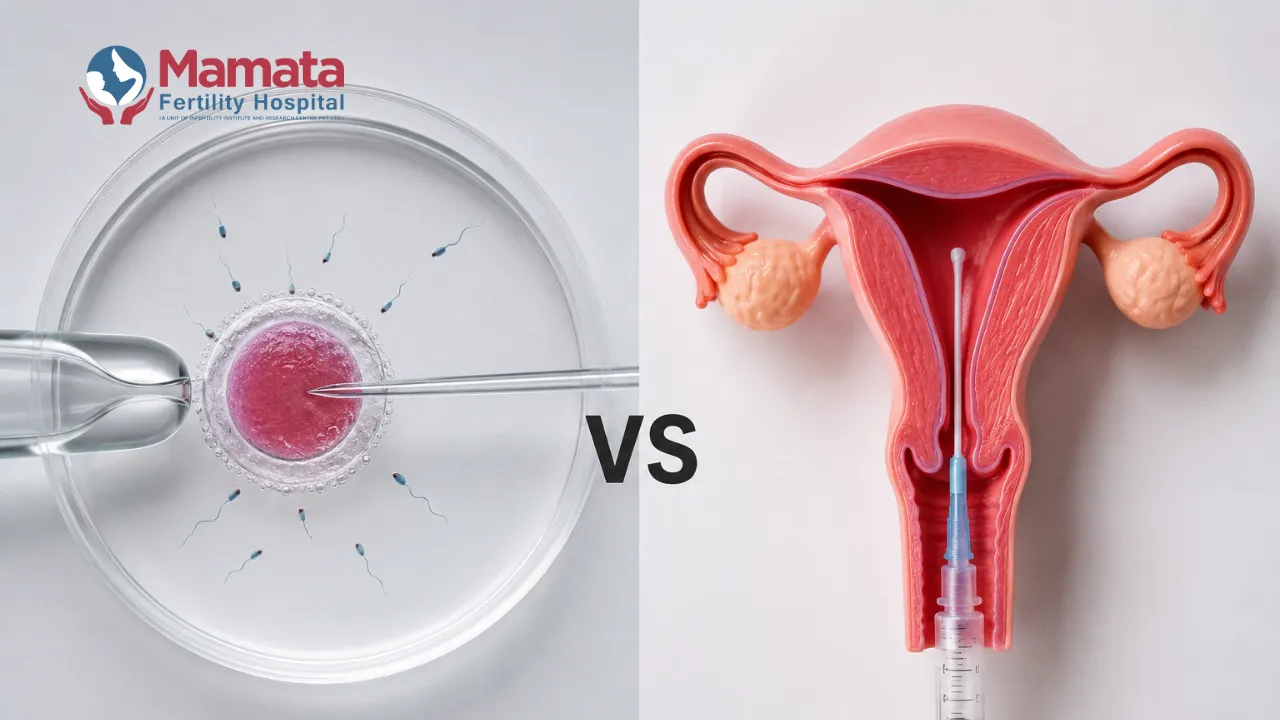
Understanding Fertility Treatments: IVF and IUI
When natural conception is taking longer than expected, medical science offers remarkable ways to assist the process. The overarching goal of all fertility treatments is simple: to help a healthy sperm meet a healthy egg in an environment that supports the growth of a beautiful baby.
However, the way we achieve that goal varies depending on your unique biological needs. IUI and IVF are the two most commonly recommended treatments worldwide. They serve the same ultimate purpose, but they operate on very different levels of medical intervention. IUI gives nature a helpful nudge, while IVF takes much more control over the biological process to overcome significant barriers. Let us explore exactly what each treatment involves.
What Is IUI (Intrauterine Insemination)?
Intrauterine Insemination, or IUI, is often the first step for couples facing mild conception challenges. It is a straightforward, relatively quick, and minimally invasive procedure.
The IUI procedure is essentially designed to give the sperm a massive head start. During natural intercourse, sperm must travel from the vagina, through the cervix, into the uterus, and finally up into the fallopian tubes to find the egg. This is a treacherous journey, and many sperm do not survive it.
How IUI works — step by step:
- Monitor ovulation — Ultrasound scans track when you are about to ovulate. Mild oral medication may be used to encourage one or two eggs to mature.
- Prepare the sperm — A semen sample is washed in the lab to remove slow or abnormal sperm, leaving only the fastest, healthiest ones.
- Inseminate — The concentrated sperm is placed inside the uterus through a thin tube. Takes 10–15 minutes, similar to a cervical smear.
- Two-week wait — A pregnancy test 14 days later confirms the result.
Learn more about IUI treatment in Hyderabad at Mamata Fertility Hospital
Do You Need a Doctor Consultation
What Is IVF (In Vitro Fertilisation)?
If IUI is a gentle nudge, In Vitro Fertilisation (IVF) is a highly advanced, comprehensive intervention. “In vitro” literally means “in glass,” reflecting the fact that fertilisation happens outside the human body in a secure, state-of-the-art laboratory.
The IVF treatment process is incredibly powerful because it allows us to bypass almost all of the internal physical barriers that might be preventing conception.
How IVF works — step by step:
- Stimulate the ovaries — Daily hormone injections for 10–12 days produce multiple eggs at once.
- Monitor response — Regular ultrasound scans and blood tests track follicle growth.
- Retrieve the eggs — A minor procedure under light sedation collects the eggs from the ovaries. Same-day discharge.
- Fertilise in the lab — Eggs are combined with sperm. If needed, a single sperm is injected directly into each egg a technique called ICSI.
- Grow the embryo — Fertilised eggs grow in a specialised incubator for 3–5 days.
- Transfer the embryo — The healthiest embryo is placed back into the uterus. Pregnancy test follows 14 days later.
Learn more about IVF treatment in Hyderabad at Mamata Fertility Hospital
IVF vs IUI: Key Differences
To help you visualise the difference between IVF and IUI, I have created a straightforward comparison table.
| Factor | IUI Treatment | IVF Treatment |
|---|---|---|
| Invasiveness | Minimal — no surgery | Moderate — minor egg retrieval |
| Where fertilisation happens | Inside the body | In the laboratory |
| Duration per cycle | 2–3 weeks | 4–6 weeks |
| Medications | Mild oral tablets | Daily injections |
| Clinic visits per cycle | 3–5 | 8–12 |
| Success rate (under 35) | 15–20% per cycle | 40–60% per cycle |
| Cost per cycle in Hyderabad | ₹18,000–₹42,000 | ₹1.2–₹2.5 lakh |
| Best for | Mild infertility, PCOS, unexplained | Blocked tubes, severe male factor, failed IUI |
| Suitable for blocked tubes | ❌ No | ✅ Yes |
| Genetic testing of embryos (PGT-A) | ❌ No | ✅ Yes |
| Emotional intensity | Lower | Higher |
Success Rates: IVF vs IUI
When couples ask me, “IUI vs IVF which is better?”, the answer always depends entirely on your specific medical diagnosis. However, looking at general success rates helps set realistic expectations.
IUI Success Rate by Age (Per Cycle)
| Age | Success Rate Per Cycle | Over 3–4 Cycles |
|---|---|---|
| Under 35 | 15–20% | 45–55% |
| 35–37 | 10–15% | 30–40% |
| 38–40 | 8–12% | 22–30% |
| Over 40 | 5–8% | 13–20% |
IVF Success Rate by Age (Per Cycle)
| Age | IVF Success Rate |
|---|---|
| Under 35 | 45–60% |
| 35–37 | 35–45% |
| 38–40 | 25–35% |
| 40–42 | 15–25% |
| Over 42 | 8–15% |
Figures reflect published clinical literature. Your personalised estimate at Mamata Fertility will be based on your specific test results.
Key insight for patients over 38: The gap between IUI and IVF success rates widens significantly with age. Spending time on multiple IUI cycles may delay a successful outcome. In many cases, choosing the Best IVF treatment in Hyderabad directly is the more effective and ultimately more cost-effective decision.
When Is IUI Recommended?
I generally recommend IUI as a first-line treatment for couples facing specific, mild barriers to conception. IUI is highly effective for:
- Mild Male Factor Infertility: If your partner’s sperm count or motility is slightly below average, washing and concentrating the sperm can overcome this hurdle.
- Unexplained Infertility: When all your diagnostic tests come back completely normal but you are still not conceiving, IUI combined with ovulation medications is often an excellent starting point.
- Ovulation Issues: For women with conditions like Polycystic Ovary Syndrome (PCOS) who do not ovulate regularly, we can use medication to prompt ovulation and use IUI to perfectly time the introduction of sperm.
- Cervical Mucus Hostility: Sometimes, the mucus in the cervix is too thick for sperm to swim through. IUI completely bypasses the cervix, solving this issue instantly.
When Is IVF Recommended?
While IUI is wonderful for mild issues, it is not a cure-all. I strongly advise couples to move directly to the IVF treatment process when we diagnose more complex medical challenges. IVF is necessary for:
- Blocked Fallopian Tubes: IUI relies on the sperm swimming up the fallopian tube to meet the egg. If your tubes are blocked or damaged, IUI simply will not work. IVF bypasses the tubes entirely.
- Severe Male Infertility: If sperm count is exceptionally low or motility is severely compromised, IUI cannot help. IVF, particularly with ICSI (sperm injection), is the definitive solution.
- Advanced Maternal Age: As women age, both the quantity and genetic quality of their eggs decline. IVF allows us to retrieve multiple eggs and even genetically test the embryos (PGT-A) to ensure we transfer the healthiest one, saving precious time.
- Severe Endometriosis: Advanced endometriosis can distort the pelvic anatomy and create an inflammatory environment. IVF removes the eggs from this toxic environment for safe fertilisation in the lab.
- Failed IUI Cycles: If you have completed three or four well-timed IUI cycles without success, it indicates a hidden barrier that IUI cannot overcome. At this stage, IVF is the logical next step.
How to Decide Between IVF and IUI?
Choosing the right path requires a delicate balance of medical science and your personal circumstances. During our consultation, we will make this decision together based on several key factors:
- Your Age: If you are under 35, we have more time to try less invasive options like IUI. If you are over 38, we may lean towards IVF to maximise your chances quickly.
- Duration of Infertility: How long have you been trying? If it has been several years, moving to a highly effective treatment like IVF may alleviate the emotional exhaustion sooner.
- Your Medical Diagnosis: This is the most crucial factor. As discussed, certain conditions absolutely mandate IVF, while others respond beautifully to IUI.
- Your Emotional Readiness: IVF requires more clinic visits, daily injections, and minor surgery. We will discuss your readiness to take on a more intensive medical protocol.
Cost Comparison: IVF vs IUI in Hyderabad
IUI Treatment Cost in Hyderabad
| Component | Estimated Cost (₹) |
|---|---|
| Initial consultation with fertility specialist | ₹2,000 – ₹3,000 |
| Ovulation induction medication | ₹3,000 – ₹10,000 |
| Follicle monitoring (ultrasound + blood tests) | ₹5,000 – ₹8,000 |
| Sperm preparation / semen washing | ₹1,500 – ₹2,500 |
| IUI insemination procedure | ₹4,000 – ₹8,000 |
| Additional medications and supplements | ₹1,000 – ₹3,000 |
| Total per cycle | ₹16,000 – ₹35,000 |
IVF Treatment Cost in Hyderabad
| Component | Estimated Cost (₹) |
|---|---|
| Initial consultation and baseline scans | ₹5,000 – ₹10,000 |
| Ovarian stimulation injections | ₹50,000 – ₹70,000 |
| Monitoring scans and blood tests | ₹15,000 – ₹20,000 |
| Egg retrieval procedure | ₹30,000 – ₹40,000 |
| Embryology lab (fertilisation and culture) | ₹25,000 – ₹35,000 |
| Embryo transfer | Included in lab charges |
| Total standard cycle | ₹1,25,000 – ₹1,75,000 |
Check Detailed IVF Treatment Cost In Hyderabad
However, it is crucial to look at the “cost per successful pregnancy.” Sometimes, spending money on multiple failed IUI cycles can eventually cost as much as moving directly to a single, highly successful IVF cycle. At Mamata Fertility Hospital, Hyderabad, we provide a completely transparent, itemised cost breakdown so you can make an informed financial decision without any hidden surprises.
Emotional and Physical Considerations
As a doctor, my focus is on your physical health, but I never lose sight of your emotional well-being. Fertility treatments are a profound emotional investment.
The IUI journey is often less physically demanding, but the “two-week wait” to see if it worked can be emotionally draining. IVF is physically more intensive, requiring daily injections that can cause temporary bloating and mood swings. The emotional stakes in IVF often feel much higher.
Please know that it is entirely normal to feel anxious, tearful, or frustrated. You must lean on your support systems. Talk to your partner, join a support group, or seek fertility counseling. At our clinic, we consider your emotional health to be just as important as your physical health, and our team is here to support you at every turn.
Why Choosing the Right Fertility Specialist Matters?
The success of your fertility treatment options relies heavily on the expertise of the medical team guiding you. Fertility is not a guessing game; it requires precise, evidence-based medicine.
An expert Fertility specialist in Hyderabad will look beyond the surface to find the true root cause of your conception struggles. They will not push you into IVF if IUI is appropriate, nor will they waste your time and emotional energy on IUI if your diagnosis clearly requires IVF. The right specialist provides rigorous monitoring, dynamically adjusts your treatment protocol based on how your body is responding, and offers unwavering ethical guidance.
Why Many Couples Choose Mamata Fertility Hospital, Hyderabad?
For decades, Mamata Fertility Hospital In Hyderabad has been a beacon of hope for couples across the region. We do not believe in a one-size-fits-all approach. When you walk through our doors, you receive highly individualised care tailored to your exact biological needs.
Couples choose us because they trust our clinical excellence. We house one of the most advanced embryology laboratories in the country, equipped with the latest technology to safeguard and nurture your embryos. Our team of senior fertility specialists, embryologists, and compassionate nursing staff work seamlessly together to provide you with world-class medical care wrapped in genuine human empathy.
Things Most Couples Don’t Know About IVF and IUI
Before we conclude, I want to share a few “insider” insights that I often discuss with my patients:
- IUI Often Requires Patience: Many couples think IUI will work on the very first try. While it can, it often takes three or four cycles to achieve success. Patience is key.
- IVF Success is Multi-Factorial: An IVF cycle might yield a perfect embryo, but the health of the uterine lining is equally important for implantation. We focus on optimising both.
- Early Consultation is Your Best Asset: The biggest regret I hear from patients is, “I wish we had come to see you sooner.” Do not wait years to seek help. Early intervention dramatically improves the outcomes for both IVF and IUI.
Frequently Asked Questions (FAQs)
-
- Is IUI painful?
No, the IUI procedure is generally not painful. Most women compare the sensation to a routine cervical smear test. You may experience mild cramping during or shortly after the procedure, but it passes quickly. - How long does the IVF treatment process take?
A single cycle of IVF usually takes about four to six weeks. This includes the time spent on daily hormone injections, the egg retrieval procedure, embryo culture in the lab, and the final embryo transfer. - Can we choose the gender of our baby with IVF?
In India, gender selection for non-medical reasons is strictly prohibited by law (under the PC-PNDT Act). We strictly adhere to these ethical and legal guidelines. - Are there any side effects to fertility medications?
Yes, the hormone medications used in both IUI and IVF can cause temporary side effects. Common symptoms include mild bloating, breast tenderness, mood swings, and occasional headaches. We monitor you closely to minimise these effects. - How many times should we try IUI before moving to IVF?
Generally, I recommend trying three to four well-timed IUI cycles. If pregnancy has not occurred by then, the statistical chance of success with further IUI cycles drops significantly, and we will usually discuss transitioning to IVF. - What is the success rate of IVF on the first try?
This depends heavily on the female partner’s age and the medical diagnosis. For women under 35, the success rate for a first IVF cycle can be 40% to 50% or higher. We will give you a specific, personalised estimate during your consultation. - Do we need to rest completely after an IUI or IVF transfer?
Strict bed rest is not medically necessary after either procedure. We recommend taking it easy on the day of the procedure, but you can generally return to your normal, non-strenuous daily activities the very next day. - Why should I choose a fertility clinic in Hyderabad over general hospital care?
A dedicated fertility clinic like Mamata Fertility Hospital focuses exclusively on reproductive endocrinology. We have specialised embryology labs and highly trained experts whose sole focus is helping you achieve a healthy pregnancy, offering advanced techniques that general hospitals simply do not provide.
- Is IUI painful?
Conclusion
Choosing between IVF and IUI is not about picking the “best” fertility treatment in general; it is about discovering the right treatment for you. IUI offers a gentle, less invasive option for mild conception hurdles, while the IVF treatment process provides a powerful, comprehensive solution for more complex medical challenges.
By understanding the difference between IVF and IUI, and by partnering with a trusted medical team, you can take control of your reproductive health. You do not have to carry the weight of this decision alone.
Take the First Step Towards Growing Your Family
If you are struggling to conceive and need expert, empathetic guidance, we are here for you. Do not let confusion delay your dream of parenthood. Let us provide the accurate diagnosis and personalised care you need to bring your baby home.
Call us or click here to schedule your appointment at Mamata Fertility Hospital, Hyderabad.

Dr Aarti Deenadayal Tolani
MBBS, MS ( OBGYN), FICOG
Clinical Director, Scientific In- Charge & Fertility Consultant with 20+ years Of Experience
Her Expertise:
CONSULT FERTILITY SPECIALIST

LATEST BLOGS

How to Read and Interpret a Semen Analysis Test Report?
Learn how to read and interpret a semen analysis report, including sperm count, motility, morphology, semen volume, vitality, Total Motile Count, and WHO 2021 reference values.

How to Choose an IVF Clinic: A Patient’s Checklist
Choosing an IVF clinic? Use this patient checklist to compare diagnosis, ART registration, success rates, costs, treatment teams, add-ons and support.

Understanding Sperm DNA Fragmentation Test and IVF Success
Understand sperm DNA fragmentation testing, DFI levels, causes of high sperm DNA damage, and how SDF can affect IVF, ICSI, embryo quality and miscarriage risk.

Oligospermia Treatment: Low Sperm Count & Pregnancy Options
Oligospermia means a low sperm count. Learn its causes, diagnosis, treatment options, IUI, IVF with ICSI, and chances of conception.
