

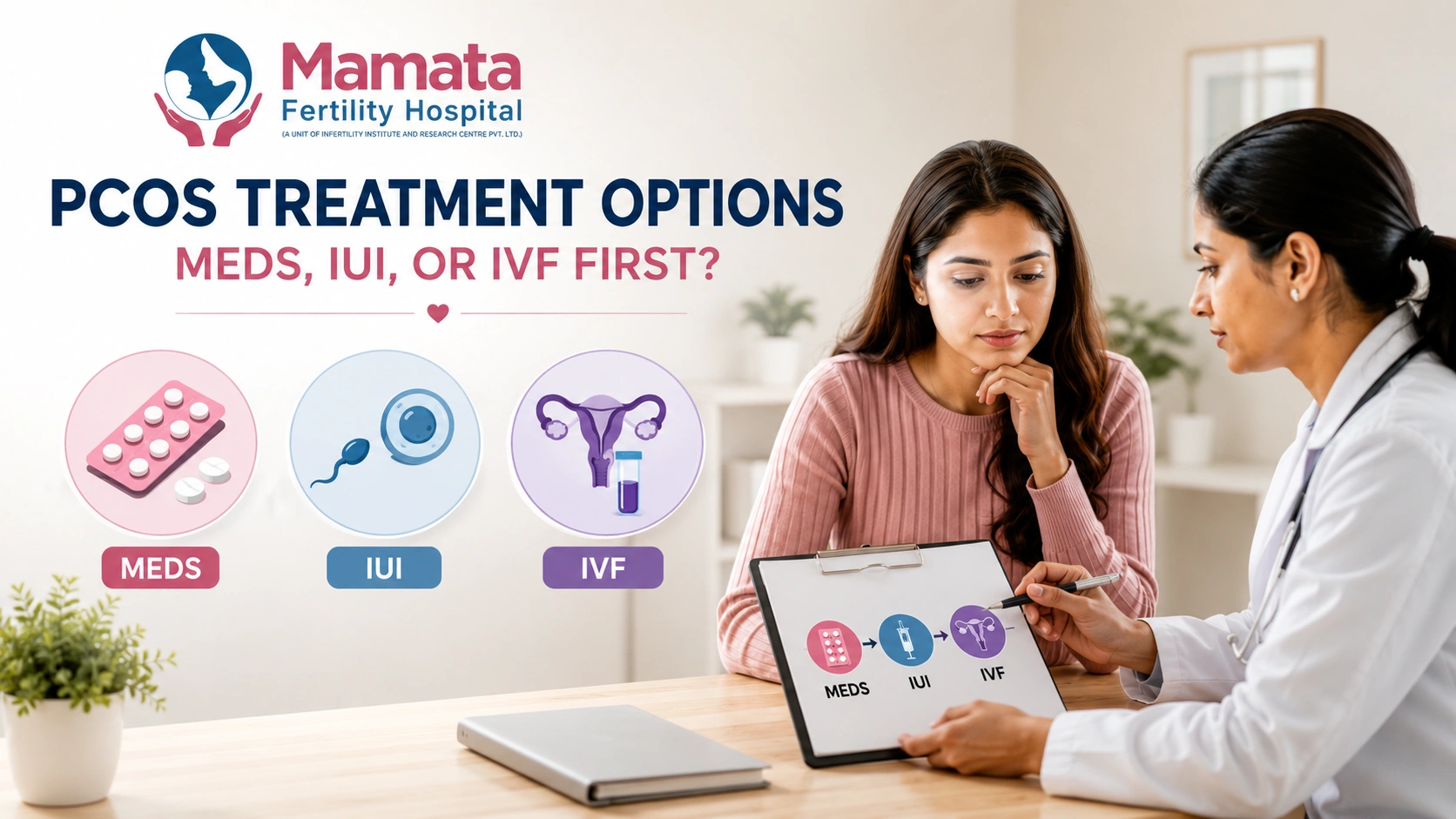
PCOS Treatment Options: Meds, IUI, or IVF First?
Welcome. I am Dr. Mamata Deenadayal. In my years of practice as a fertility specialist at Mamata Fertility Hospital, Hyderabad, I have met countless women sitting exactly where you are right now. You have just been diagnosed with Polycystic Ovary Syndrome (PCOS), and while it is a relief to finally have a name for your symptoms, it also brings a wave of anxiety.
When you are trying to conceive, a PCOS diagnosis can make the journey feel incredibly overwhelming. Many women walk into my clinic confused by the sheer volume of information online. They ask me, “Do I need to jump straight to IVF? Will simple medications work? What comes first?”
Please take a deep breath. You do not have to figure this out alone, and you certainly do not need to rush into the most complex treatments immediately. PCOS fertility treatment is a highly structured, step-by-step process. In this guide, I will walk you through the exact sequence of PCOS treatment options we use to help you build your family, starting with the simplest interventions and only moving to advanced care when truly necessary.
What Is PCOS and How Does It Affect Fertility?
Before we discuss the treatments, we must understand the condition itself. Polycystic Ovary Syndrome (PCOS) is a common hormonal disorder affecting women of reproductive age.
Despite the name, you do not actually have “cysts” on your ovaries in the traditional sense. Instead, your ovaries contain multiple small, resting follicles that have not matured properly. This happens because PCOS causes a hormonal imbalance, typically involving higher levels of androgens (male hormones) and insulin resistance.
This hormonal imbalance disrupts the delicate communication between your brain and your ovaries. As a result, your ovaries struggle to mature and release an egg each month. This lack of regular ovulation (anovulation) is the primary reason why women with PCOS experience difficulty conceiving. If an egg is not released, sperm has nothing to fertilise, making pregnancy biologically impossible during that cycle.
Why Treatment Order Matters in PCOS
One of the greatest myths about PCOS is that it automatically equals severe infertility requiring immediate, aggressive intervention. This is simply not true.
Not all patients need IVF immediately. In fact, a significant percentage of women with PCOS will conceive with very minimal medical help. The sequence of your treatment depends heavily on your age, your specific hormone levels, and your overall fertility goals.
Understanding the correct sequence of PCOS treatment options is vital. It protects you from undergoing unnecessary, costly, and emotionally taxing procedures before you actually need them. We always want to start with the least invasive, most natural methods possible, allowing your body the chance to respond before stepping up to higher levels of medical assistance.
Step 1: Lifestyle Changes (The Foundation of PCOS Treatment)
Before I ever prescribe a single tablet or injection, we must look at your daily habits. Lifestyle modification is the absolute bedrock of PCOS fertility treatment.
- Weight Management: Many women with PCOS struggle with insulin resistance, which makes weight gain easy and weight loss difficult. However, losing just 5% to 10% of your total body weight can dramatically lower insulin and androgen levels. For many women, this modest weight loss is enough to restart natural ovulation completely on its own.
- Diet and Exercise: Transitioning to a low-glycaemic diet rich in whole foods, lean proteins, and fresh vegetables helps stabilise your blood sugar. Combining this with moderate, regular exercise (like brisk walking or swimming) improves your body’s sensitivity to insulin.
- Stress Reduction: High stress elevates cortisol, which further disrupts your reproductive hormones. Incorporating gentle yoga, meditation, or even just dedicated time for relaxation is a medical necessity, not a luxury.
Step 2: Medications for Ovulation Induction
If lifestyle changes alone do not bring back your regular menstrual cycles, we move to the first medical step: ovulation induction PCOS protocols.
These are straightforward, non-invasive treatments designed to help your ovaries do what they are supposed to do.
- Oral Medications: Drugs such as Letrozole or Clomiphene Citrate are usually our first choice. You take these tablets for a few days at the start of your cycle. They work by gently blocking oestrogen receptors, which tricks your brain into producing more Follicle-Stimulating Hormone (FSH). This extra FSH pushes your ovaries to mature and release an egg.
- Insulin-Sensitising Drugs: Sometimes, we prescribe Metformin alongside ovulation medications. Metformin helps your body process insulin more effectively, which in turn lowers androgen levels and improves your response to the ovulation drugs.
- Cycle Monitoring: While taking these medications, you will visit our clinic for ultrasound scans. This allows us to track the growth of your follicles and tell you exactly which days are the most fertile for intercourse.
Need Help Starting Your Treatment Journey?
If you have been diagnosed with PCOS and want to know your best next step, do not wait in uncertainty. Book a consultation at Mamata Fertility Hospital, Hyderabad for a clear, compassionate assessment.
Step 3: When Is IUI Recommended?
If you have tried several cycles of ovulation induction medications with perfectly timed intercourse but have not conceived, we step up to Intrauterine Insemination (IUI).
IUI treatment for PCOS is a fantastic, moderate-level intervention. During an IUI cycle, we use medications to stimulate ovulation, just as in Step 2. However, instead of natural intercourse, your partner provides a semen sample on the day of ovulation.
In our laboratory, we wash and concentrate this sperm, isolating the strongest, most motile swimmers. I then use a very fine catheter to place this concentrated sperm directly into your uterus.
Who benefits from IUI? IUI is highly recommended if, alongside your PCOS, there is a mild male-factor infertility issue (like slightly low sperm motility), or if the mucus in your cervix is too thick for sperm to navigate easily. It gives the sperm a massive head start, placing them right next to the fallopian tubes where the egg is waiting.
Step 4: When IVF Becomes Necessary
For some women, medications and IUI are not enough. This is when we discuss moving to In Vitro Fertilisation (IVF).
IVF for PCOS patients is a highly advanced, powerful treatment. Instead of trying to make fertilisation happen inside your body, we take control of the entire process. You will take injectable hormones to mature multiple eggs. We then retrieve these eggs under light sedation and fertilise them with sperm in our state-of-the-art embryology laboratory. The resulting embryo is then transferred directly into your uterus.
When is PCOS IVF treatment recommended?
- If you have completed three to four unsuccessful IUI cycles.
- If you are over the age of 35 and time is a critical factor.
- If you have additional fertility barriers, such as blocked fallopian tubes.
- If your partner has severe male-factor infertility.
Women with PCOS often have very high success rates with IVF because they typically produce a large number of eggs during the stimulation phase, giving us many excellent chances to create healthy embryos.
PCOS Treatment Options: A Comparison
To make these choices clearer, I have created a comparison table outlining your options.
| Treatment | When Used | Invasiveness | Success Rate | Cost Level | Best For |
| Medications | First step | Low | Moderate | Low | Mild PCOS, anovulation |
| IUI | Next step | Moderate | Moderate | Medium | PCOS with mild male factor |
| IVF | Advanced step | High | High | High | Complex cases, failed IUI |
How do doctors decide the right treatment path?
As an expert fertility specialist in Hyderabad, I do not believe in a one-size-fits-all approach. When you sit in my consultation room, we decide your treatment path together based on hard medical data.
- Age of Patient: If you are in your early twenties, we have time to try several cycles of medication. If you are in your late thirties, we might move to IUI or IVF much sooner.
- Duration of Infertility: If you have been trying for three years without success, we will be more proactive than if you have only been trying for six months.
- Hormone Levels: Your Anti-Müllerian Hormone (AMH) and specific androgen levels tell me exactly how your ovaries will likely respond to different medications.
- Previous Treatment History: If you have already tried Letrozole with your general gynaecologist without success, it is time for us to look at the next tier of treatment.
What Most Patients Get Wrong About PCOS Treatment
In my experience, anxiety often leads patients to make decisions that do not serve their best interests. Here are the most common mistakes I see:
- Jumping Directly to IVF: Many women assume PCOS means they must have IVF. This is a myth. The vast majority of my PCOS patients conceive with simple medications or IUI. We only use IVF when absolutely necessary.
- Ignoring Lifestyle Changes: Medication is not a magic wand. If you take ovulation drugs but maintain a highly inflammatory diet and poor sleep habits, the medications will not work effectively. Your body needs a healthy foundation to respond to treatment.
- Delaying Treatment: Conversely, some women wait years, hoping their periods will regulate naturally. If your cycles are irregular, do not wait. Early diagnosis and gentle intervention prevent years of unnecessary heartbreak.
Ready to Find Your Custom Treatment Path?
Stop guessing and start moving forward with confidence. Reach out to our expert team to understand exactly which treatment step is right for you. Contact Mamata Fertility Hospital, Hyderabad, today.
Do You Need a Doctor Consultation
What to Expect During Each Treatment Stage?
Knowing what is coming helps calm the mind. Here is a brief look at your journey with us:
- Consultation: We will talk extensively about your medical history, your menstrual cycles, and your emotional wellbeing.
- Diagnosis: We will run precise blood tests and perform a transvaginal ultrasound to assess your ovarian reserve and confirm the PCOS diagnosis.
- Stepwise Treatment: We will start with the least invasive option suitable for your profile, whether that is lifestyle coaching or ovulation medication.
- Monitoring: You are never left alone. We monitor you closely with blood tests and scans to ensure the medications are working safely and effectively.
Success Rates and Realistic Expectations
It is my duty to be completely honest with you: no fertility treatment guarantees a 100% success rate on the very first try.
Patience is your greatest ally here. Sometimes, it takes a few cycles for us to find the exact dosage of medication your body needs to ovulate. Sometimes, an IUI cycle fails simply due to statistics, not because your body is “broken.”
However, the outlook for women with PCOS is incredibly bright. Because women with PCOS generally have a very high egg reserve, your overall chances of taking a baby home,when guided by the correct, step-by-step medical approach,are exceptionally good. Success improves drastically when you partner with a clinic that prioritises accurate, sequential treatment over rushed procedures.
Why Choose Mamata Fertility Hospital, Hyderabad?
When you are facing a complex hormonal condition like PCOS, the expertise of your medical team matters more than ever.
As a leading IVF center in Hyderabad, Mamata Fertility Hospital is built on a foundation of profound clinical excellence and unwavering ethical care. Under my guidance, our team ensures you receive deeply personalised treatment. We do not push you into expensive procedures you do not need. Instead, we use our advanced diagnostic tools and decades of experience to map out a logical, safe, and highly effective path to parenthood.
Our patients trust us because we communicate transparently. We explain the “why” behind every single medication and scan, ensuring you feel empowered and respected throughout your entire journey with us.
Emotional Support and Patient Guidance
I want to take a moment to acknowledge the emotional weight you are carrying. The journey through PCOS fertility treatment can feel like an emotional rollercoaster. The monthly waiting, the counting of days, and the sight of negative pregnancy tests can leave you feeling deeply depleted.
Please know that your mental health is a critical component of your fertility. At our clinic, we provide comprehensive emotional support and professional counselling. We encourage you to talk about your fears, lean on your partner, and lean on our medical team. You are not just a patient file to us; you are a future mother, and we are here to support your mind just as much as your body.
Frequently Asked Questions (FAQs)
-
- Does freezing damage the embryo?
No. We use an advanced rapid-freezing technique called vitrification. It prevents ice crystals from forming inside the embryo. Over 95% of high-quality embryos survive the freezing and thawing process without any damage. - How long can embryos stay frozen?
Embryos can remain safely frozen in liquid nitrogen indefinitely. There are many recorded cases of healthy babies being born from embryos that were frozen for ten, fifteen, or even twenty years. - Is a frozen embryo transfer painful?
No, an FET is generally painless. It feels very similar to a routine cervical smear test. You do not need anaesthesia, and the procedure only takes a few minutes. - Why do doctors cancel fresh transfers?
I will cancel a fresh transfer and freeze your embryos if your hormone levels (like progesterone) are too high, if your uterine lining is too thin, or if you are showing early signs of Ovarian Hyperstimulation Syndrome (OHSS). This is done entirely for your safety and to protect your chances of success. - Do frozen transfers result in healthier babies?
Extensive medical studies show that babies born from frozen embryo transfers are just as healthy as those born from fresh transfers or natural conception. Some studies even suggest FET babies have a slightly lower risk of being born prematurely or with a low birth weight. - Can I choose to have a frozen transfer even if I qualify for a fresh one?
Yes, absolutely. Many patients opt for a “freeze-all” cycle simply because it allows their body to recover from the stress of the stimulation medications before attempting pregnancy. We can discuss this preference during your consultation.
- Does freezing damage the embryo?
Conclusion
The debate between frozen embryo transfer vs fresh transfer is not about which technology is universally better; it is about which method provides the most optimal, receptive environment for your embryo to thrive. While fresh transfers remain an excellent option for patients with balanced hormones and healthy linings, frozen embryo transfers have revolutionised our ability to protect patient safety, perform genetic testing, and perfectly time implantation for maximum success.
You do not have to make this complex medical decision alone. A thorough evaluation by an expert team will reveal the clearest, safest path forward for your family.
Take the First Step Towards Growing Your Family
If you are struggling to conceive and need expert, empathetic guidance, we are here for you. Book your consultation with Dr Mamata Deenadayal at Mamata Fertility Hospital, Hyderabad today. Let us provide the accurate diagnosis, the advanced technology, and the personalised care you need to bring your baby home.
Call us or click here to schedule your appointment at Mamata Fertility Hospital, Hyderabad.

Dr Aarti Deenadayal Tolani
MBBS, MS ( OBGYN), FICOG
Clinical Director, Scientific In- Charge & Fertility Consultant with 20+ years Of Experience
Her Expertise:
CONSULT FERTILITY SPECIALIST

LATEST BLOGS

How to Read and Interpret a Semen Analysis Test Report?
Learn how to read and interpret a semen analysis report, including sperm count, motility, morphology, semen volume, vitality, Total Motile Count, and WHO 2021 reference values.

How to Choose an IVF Clinic: A Patient’s Checklist
Choosing an IVF clinic? Use this patient checklist to compare diagnosis, ART registration, success rates, costs, treatment teams, add-ons and support.

Understanding Sperm DNA Fragmentation Test and IVF Success
Understand sperm DNA fragmentation testing, DFI levels, causes of high sperm DNA damage, and how SDF can affect IVF, ICSI, embryo quality and miscarriage risk.

Oligospermia Treatment: Low Sperm Count & Pregnancy Options
Oligospermia means a low sperm count. Learn its causes, diagnosis, treatment options, IUI, IVF with ICSI, and chances of conception.
