

Can Fibroids Be Cancerous? What the Real Risk Is
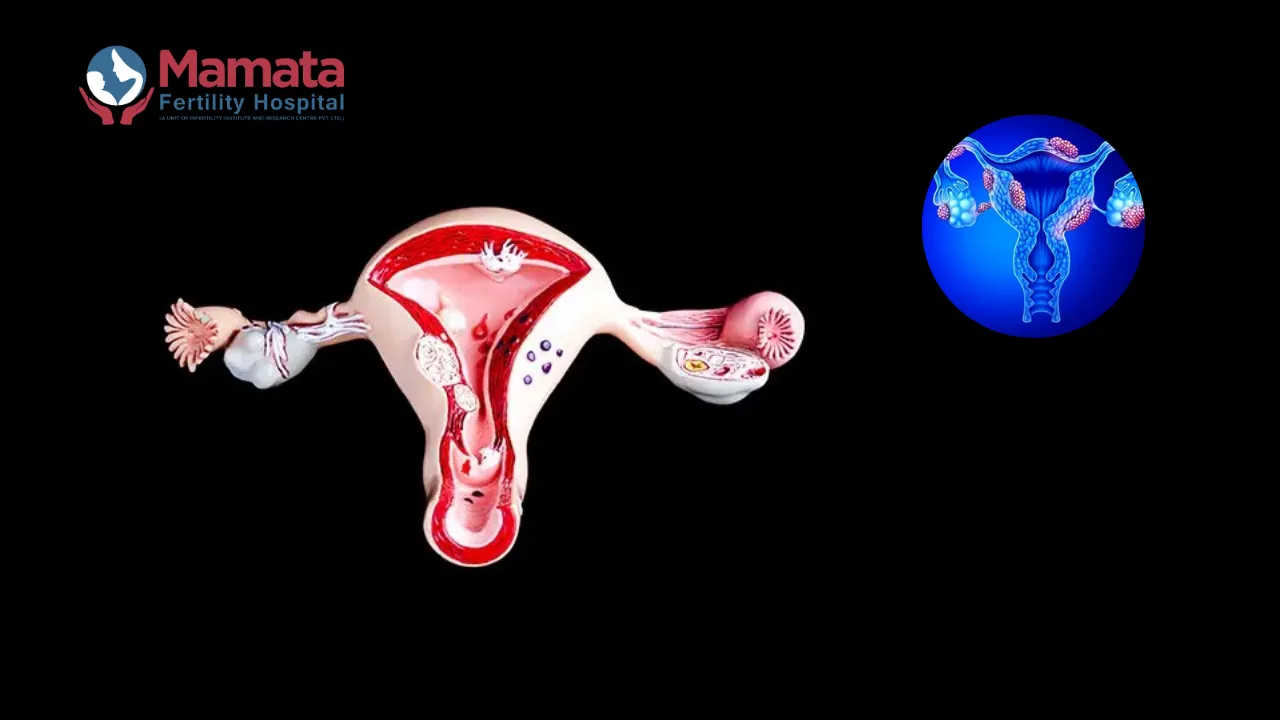
Quick answer: Fibroids are almost always benign, which means not cancer. A normal fibroid does not turn into cancer over time. Very rarely, a cancer called uterine sarcoma (most often leiomyosarcoma) starts in the uterus and looks like a fibroid on a scan. This is uncommon, and the risk is higher after menopause.
Key takeaways
- Fibroids are very common and benign.
- Fibroids do not “turn into” cancer. A rare cancer can look like a fibroid from the start.
- Warning signs include a growth that keeps growing after menopause, and bleeding after menopause.
- Scans help, but no scan can fully rule out cancer before surgery. Your doctor weighs the scan with your age and symptoms.
- Most women with fibroids need either no treatment or treatment only for symptoms.
What Is a Fibroid? Is It a Tumour?
A fibroid is a growth made of muscle tissue in the wall of the uterus. Its medical name is leiomyoma. It is also called a myoma, and in Hindi, rasoli.
Yes, a fibroid is a type of tumour. But “tumour” only means a lump of extra tissue. It does not mean cancer. Fibroids are benign tumours: they do not spread to other parts of the body.
Fibroids are extremely common. In US studies, about 70% of white women and 80% of Black women have fibroids by age 50. Most cause no symptoms. About 15% to 30% of women with fibroids develop severe symptoms.
Learn more on our Uterine Fibroids page.
Can a Fibroid Turn Into Cancer?
Quick answer: No. Doctors do not believe a normal fibroid changes into cancer.
The rare cancer that can look like a fibroid, called leiomyosarcoma, is thought to be a different growth from the beginning. It is not an old fibroid that has “gone bad.”
This also means that leaving a fibroid untreated does not make it more likely to become cancer. Treatment decisions are based on your symptoms and plans, not on fear that the fibroid will turn cancerous.
How Often Are Fibroids Actually Cancer?
Quick answer: Rarely. Among women who have surgery for what looks like a fibroid, a small number turn out to have a hidden uterine cancer. Among all women with fibroids, most of whom never need surgery, the chance is lower still.
Table 1: The real numbers
|
What was measured |
Estimate |
Source |
|
Women with fibroids by age 50 (US) |
About 70% (white) to 80% (Black) |
Merck Manual, citing Baird et al. |
|
Hidden uterine sarcoma in women having surgery for presumed fibroids |
About 1 in 225 to 1 in 580 |
US FDA review, 2017 |
|
Hidden leiomyosarcoma specifically |
About 1 in 495 to 1 in 1,100 |
US FDA review, 2017 |
|
Women over 60 |
Hidden sarcoma rates were much higher, around 2% to 3% |
FDA review findings |
Why the numbers vary: they come from women who had surgery, often because their growth was large, fast-growing or causing symptoms. That group has a higher risk than women with small, quiet fibroids found on a routine scan. Some medical organisations have reported lower estimates than the FDA’s.
The most important point: age matters. The risk is very low in younger women and rises after menopause.
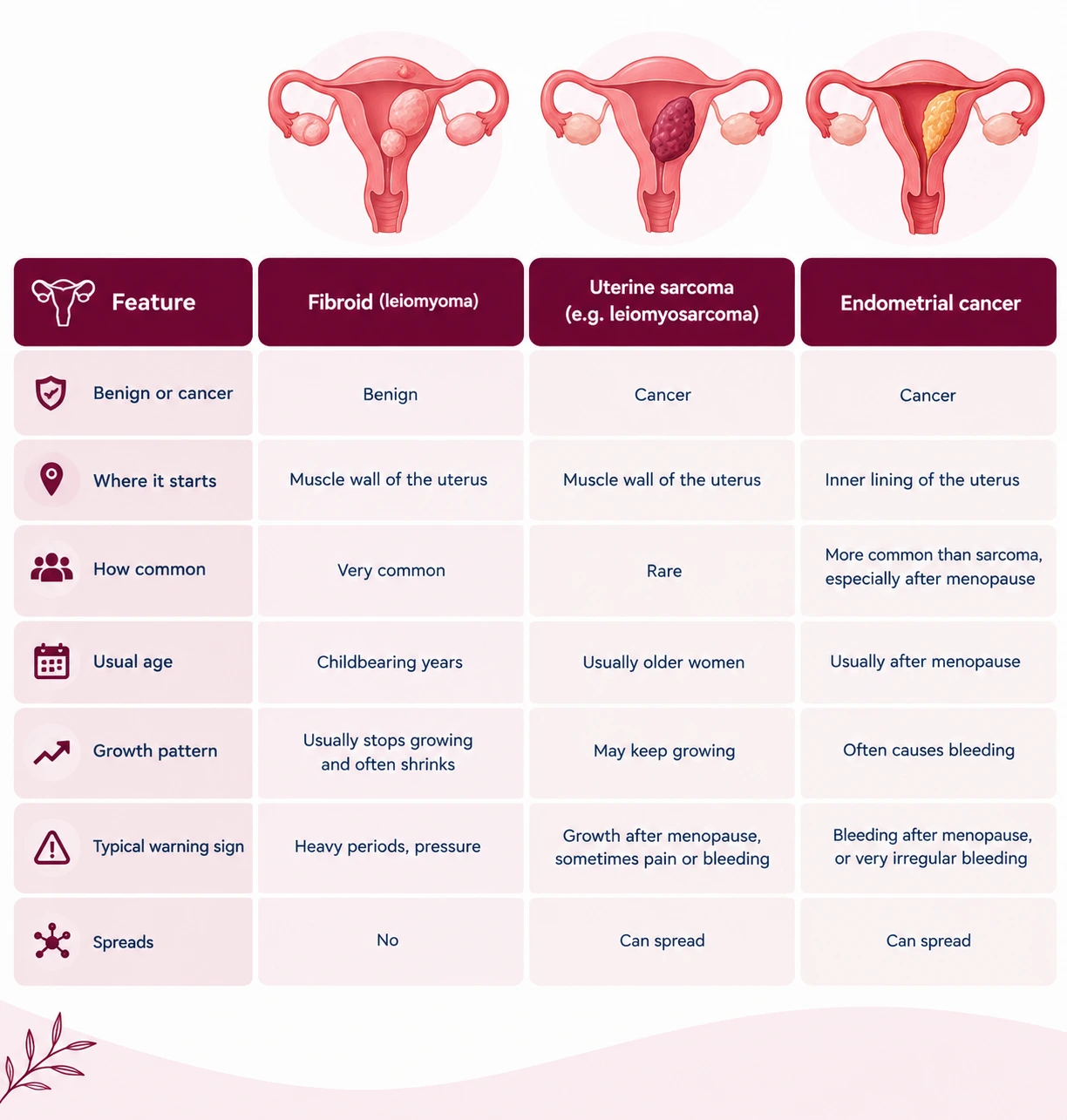
Fibroid vs Cancer: How Are They Different?
Table 2: Fibroid, uterine sarcoma and endometrial cancer compared
|
Feature |
Fibroid (leiomyoma) |
Uterine sarcoma (e.g. leiomyosarcoma) |
Endometrial cancer |
|
Benign or cancer |
Benign |
Cancer |
Cancer |
|
Where it starts |
Muscle wall of the uterus |
Muscle wall of the uterus |
Inner lining of the uterus |
|
How common |
Very common |
Rare |
More common than sarcoma, especially after menopause |
|
Usual age |
Childbearing years |
Usually older women |
Usually after menopause |
|
After menopause |
Usually stops growing and often shrinks |
May keep growing |
Often causes bleeding |
|
Typical warning sign |
Heavy periods, pressure |
Growth after menopause, sometimes pain or bleeding |
Bleeding after menopause, or very irregular bleeding |
|
Spreads |
No |
Can spread |
Can spread |
Fibroids usually stop growing at menopause and may shrink. This is why a growth that keeps growing after menopause needs closer evaluation.
Symptoms: Fibroid or Something More Serious?
Quick answer: Fibroid and cancer symptoms can overlap, so symptoms alone cannot tell them apart. Certain signs, especially after menopause, mean you should see a gynaecologist promptly.
Table 3: Common fibroid symptoms vs signs to get checked soon
|
Usually due to fibroids |
See a doctor promptly |
|
Heavy or long periods (menorrhagia) |
Any bleeding after menopause |
|
Pelvic pressure or fullness |
A fibroid that grows after menopause |
|
Frequent urination |
A growth that grows quickly over a few months |
|
Constipation or bloating |
New, worsening pelvic pain |
|
Backache |
Unexplained weight loss or tiredness |
|
Painful periods |
Bleeding between periods that is new or keeps happening |
Having a sign from the right-hand column does not mean you have cancer. It means you need a proper check-up rather than waiting.
Is a fast-growing fibroid cancer? Not usually. Fibroids can grow quickly in younger women, especially during pregnancy. Rapid growth matters most after menopause, when fibroids should be shrinking.
How Doctors Tell a Fibroid From Cancer
Quick answer: Ultrasound is the first test. MRI and tests of the uterine lining may follow. A biopsy is the only way to be sure, but a biopsy of the uterine lining cannot always reach a growth in the muscle wall.
Table 4: Tests and what they show
|
Test |
What it shows |
Limits |
|
Size, number and position of fibroids |
Cannot reliably tell a fibroid from a sarcoma |
|
|
A detailed map of each fibroid, useful for planning treatment |
Same limits as ultrasound |
|
|
Fibroids or polyps inside the cavity |
Does not assess the muscle wall in full |
|
|
MRI |
More detail on unusual-looking growths |
Helpful, but still cannot fully rule out sarcoma |
|
Endometrial biopsy |
Checks the uterine lining for endometrial cancer |
May miss a sarcoma in the muscle wall |
|
Tissue check after surgery |
Final answer under the microscope |
Only after removal |
Transvaginal ultrasound is the standard imaging test for fibroids, but it has not been shown to tell leiomyosarcoma apart from a fibroid. That is why your doctor looks at the whole picture: your age, symptoms, scan pattern and how the growth changes over time.
For cancer-specific evaluation, see Uterine Cancer Diagnosis and Endometrial Cancer Diagnosis.
What Size of Fibroid Is Dangerous?
Quick answer: Size alone does not mean cancer. A large fibroid, even 10 to 12 cm, is usually still benign. But size affects symptoms, fertility and the type of treatment.
Table 5: What fibroid size usually affects
|
Fibroid size |
What it may affect |
|
Small (under 3 cm) |
Often no symptoms; may matter for fertility if inside the cavity |
|
Medium (3 to 7 cm) |
Heavy periods and pressure, depending on position |
|
Large (over 7 to 10 cm) |
Pressure on bladder or bowel, a swollen abdomen, and more complex surgery |
Position often matters more than size. A small fibroid inside the uterine cavity (submucosal) can cause heavier bleeding and fertility problems than a larger one on the outside (subserosal or exophytic).
Can Cancer Be Mistaken for a Fibroid?
Yes, rarely. This is the main reason fibroids and cancer get linked. A uterine sarcoma can look like a fibroid on ultrasound. Sometimes it is only found when the tissue is examined after surgery.
What this means for you if you need surgery: ask your surgeon how the fibroid will be removed. In laparoscopic surgery, large fibroids are sometimes cut into small pieces inside the body (morcellation). Regulators have warned that if an unexpected cancer is present, this can spread it. Many surgeons now use a protective bag (contained morcellation), or choose another approach for women at higher risk. It is a reasonable question to ask. See Fibroid Removal Surgery.
Do Fibroids Increase the Risk of Other Cancers?
|
Question |
Short answer |
|
Do fibroids cause uterine cancer? |
Fibroids do not turn into cancer. Endometrial cancer starts in the lining, not in a fibroid. |
|
Fibroids and endometrial cancer |
They are separate conditions, but both can cause abnormal bleeding, so bleeding should be checked, especially after 45 or after menopause. See Endometrial Cancer. |
|
Fibroids and cervical cancer |
No known link. Keep up regular cervical screening and Pap smears. |
|
“Ovarian fibroids” |
Fibroids grow in the uterus, not the ovary. A solid ovarian growth called a fibroma is a different, usually benign, condition. Any ovarian mass needs its own evaluation. See Ovarian Cysts and Ovarian Cancer Screening. |
|
Thickened uterine lining |
This is not a fibroid. It needs evaluation, especially with bleeding after menopause. |
Fibroids and Fertility
For many women, the bigger question is not cancer but whether fibroids will affect pregnancy. Fibroids, especially those inside the uterine cavity (submucosal), can be linked with difficulty conceiving.
Table 6: Fibroid type and fertility
|
Fibroid type |
Where it is |
Effect on fertility |
Common approach |
|
Submucosal |
Bulges into the uterine cavity |
Most likely to affect fertility |
Often removed by hysteroscopy |
|
Intramural |
Inside the muscle wall |
May affect fertility if large or distorting the cavity |
Depends on size and position |
|
Subserosal / exophytic |
On the outer surface |
Usually little effect |
Usually monitored |
If you are trying to conceive, a fibroid mapping scan helps decide whether a fibroid needs treatment before trying, or before IVF. See also Female Fertility Treatment.
Myths and Facts
Common myths
| Myth | Fact |
| Fibroids turn into cancer if left alone | A normal fibroid does not change into cancer |
| A big fibroid must be cancer | Size alone does not mean cancer |
| Every fibroid must be removed | Fibroids without symptoms usually only need monitoring |
| An ultrasound can rule out cancer completely | Scans help, but cannot fully rule out a rare sarcoma |
| Fibroids are always painful | Many women have no symptoms at all |
When to See a Doctor
Book a gynaecology consultation if you:
- have bleeding after menopause
- have been told a fibroid is growing after menopause
- have very heavy periods, or feel tired or breathless (possible anaemia)
- have pelvic pressure, frequent urination or a swollen lower abdomen
- are trying to conceive and have been told you have fibroids
Worried about a fibroid on your scan? Our gynaecologists in Secunderabad can review your reports and advise whether you need further tests or simply monitoring.
- Book a Fibroid Mapping Scan
- Book a Consultation
- Call +91 8790337035 or 040 45678899
Sources:
FAQ
Can fibroids be cancerous?
Fibroids themselves are benign. Rarely, a cancer called uterine sarcoma can look like a fibroid on a scan. The risk is low, and higher after menopause.
Can a fibroid turn into cancer?
No. Doctors believe the rare cancer that resembles a fibroid starts as a different growth. It is not a fibroid that changed.
Can untreated fibroids cause cancer?
No. Leaving a fibroid untreated does not make it turn into cancer. Treatment depends on symptoms and your plans.
How can you tell if a fibroid is cancerous?
There is no single sign. Warning signs include growth after menopause and bleeding after menopause. Ultrasound and MRI help, but the final answer comes from examining the tissue under a microscope.
Is a myoma or rasoli cancer?
No. Myoma and rasoli are other names for a fibroid, which is a benign growth.
Is a fibroid a tumour?
Yes, but a benign one. “Tumour” means a lump of tissue, not necessarily cancer.
Can fibroids kill you?
Fibroids themselves are not life-threatening. Very heavy bleeding can cause anaemia, which needs treatment. Rarely, a cancer can be mistaken for a fibroid, which is why warning signs should be checked.
What is the survival rate of fibroid cancer?
Fibroids are not cancer, so they have no “survival rate.” For the rare uterine sarcoma, the outlook depends mainly on how early it is found. A gynae-oncologist can explain it for an individual case.

Dr Aarti Deenadayal Tolani
MBBS, MS ( OBGYN), FICOG
Clinical Director, Scientific In- Charge & Fertility Consultant with 22+ years Of Experience
TSMC Reg. No. 51895
Her Expertise:
CONSULT FERTILITY SPECIALIST

LATEST BLOGS

How to Get Periods Immediately to Avoid Pregnancy?
Home > Blogs > How to Get...

How to Stop Prolonged Periods?
Periods lasting over 7 days need a check-up. Learn simple steps that help, the medicines doctors use to stop heavy bleeding, and the warning signs to watch for.

How to Avoid Pregnancy Naturally?
Natural methods like ovulation tracking can lower pregnancy risk, but they fail more often than other methods. See how they work and what to do after unprotected sex.

How to Increase Endometrial Thickness for IVF?
A lining of about 7 to 8 mm or more is usually ideal for embryo transfer. Learn the medical treatments that help a thin lining, realistic timelines and food tips.
