

What is BPD in Pregnancy?
Medically reviewed by Dr. Aarti Deenadayal Tolani,
Fertility Specialist & IVF Expert, Mamata Fertility Hospital, Hyderabad

Understanding the growth and health of your baby during pregnancy is a top priority for any expecting mother. One key measurement that healthcare providers use to monitor this development is the Biparietal Diameter (BPD). If you’re wondering, “What is BPD in pregnancy?” and why it’s important, you’re in the right place. This guide will help you understand what BPD means, how it is measured, and how it supports your baby’s healthy development.
What is BPD Meaning in Pregnancy?
Biparietal Diameter, often abbreviated as BPD, refers to the measurement of the width of your baby’s head from one side to the other. This measurement is typically taken during an ultrasound during pregnancy. By assessing BPD, doctors can estimate your baby’s gestational age, monitor brain development, and track overall fetal growth.
It’s a crucial part of routine fetal growth measurements because brain growth and head development are closely linked to your baby’s health.
How is BPD Measured in Pregnancy?
Taking a BPD measurement involves using specialized ultrasound equipment. During your ultrasound appointment, a trained sonographer or doctor will use high-frequency sound waves to capture an image of your baby inside the womb. From this image, the measurement of the baby’s head width at its widest point is recorded.
BPD measurements are usually done starting around 13 weeks of pregnancy and are closely monitored throughout the second and third trimesters. These readings help doctors compare your baby’s progress to standardized growth charts.
What Does a Normal BPD Range Indicate?
The BPD ranges vary depending on your stage of pregnancy. Here’s a rough guide to what normal ranges might look like:
- At 20 weeks gestation: BPD typically measures around 4.4 to 4.7 cm.
- At 28 weeks gestation: BPD increases to approximately 7.2 to 7.6 cm.
- At 36 weeks gestation and beyond: The measurement reaches about 8.6 to 9.6 cm.
A BPD within these ranges indicates healthy and consistent fetal brain and skull growth. However, the healthcare provider also interprets this result alongside other fetal measurements, such as the head circumference (HC), abdominal circumference (AC), and femur length (FL), for a complete view of your baby’s development.
What Happens if BPD is Smaller or Larger Than Average?
It’s natural to feel concerned if your baby’s BPD measurement isn’t exactly within the “normal” range. Here’s what you need to know:
Smaller BPD
- A smaller-than-average BPD may suggest slower fetal growth or a condition known as intrauterine growth restriction (IUGR).
- Your doctor may conduct further investigations, such as doppler blood flow studies or additional ultrasounds, to evaluate the cause.
Larger BPD
- A larger-than-average BPD could indicate that the baby has a larger head size, which may be hereditary or due to extra space for cerebrospinal fluid (a condition called ventriculomegaly in rare cases).
- This isn’t always a cause for concern but may prompt additional checks.
Fortunately, advanced Fertility care centres like Mamata Fertility Hospital Hyderabad provide expert evaluations and cutting-edge technology to ensure accurate and timely diagnosis if any abnormalities arise.
Factors That May Affect BPD Measurements
Several factors can influence your baby’s BPD measurement. These include:
- Incorrect gestational age estimation: If conception timing is unclear, it might lead to BPD measurement mismatches with standard growth charts.
- Maternal health conditions: Conditions such as diabetes or hypertension can impact fetal growth patterns.
- Position of the baby: Sometimes, fetal positioning during the ultrasound can affect the accuracy of the measurement.
Your healthcare provider will account for these factors when interpreting results to provide the best possible care.
BPD in Pregnancy: What Does Your Ultrasound Number Mean?
BPD stands for biparietal diameter. It is the width of the baby’s head measured from one side of the skull to the other during an ultrasound. Doctors use BPD as one part of fetal biometry to monitor growth and, in some stages of pregnancy, help assess gestational age.
BPD Is Not the Only Baby Measurement
An ultrasound report usually includes several measurements. Each one looks at a different part of your baby’s growth.
| Measurement | What It Means |
|---|---|
| BPD | Width of the baby’s head |
| HC | Circumference of the head |
| AC | Circumference of the abdomen |
| FL | Length of the thigh bone |
Doctors look at these measurements together rather than judging your baby’s health from BPD alone.
BPD Normal Range by Pregnancy Week
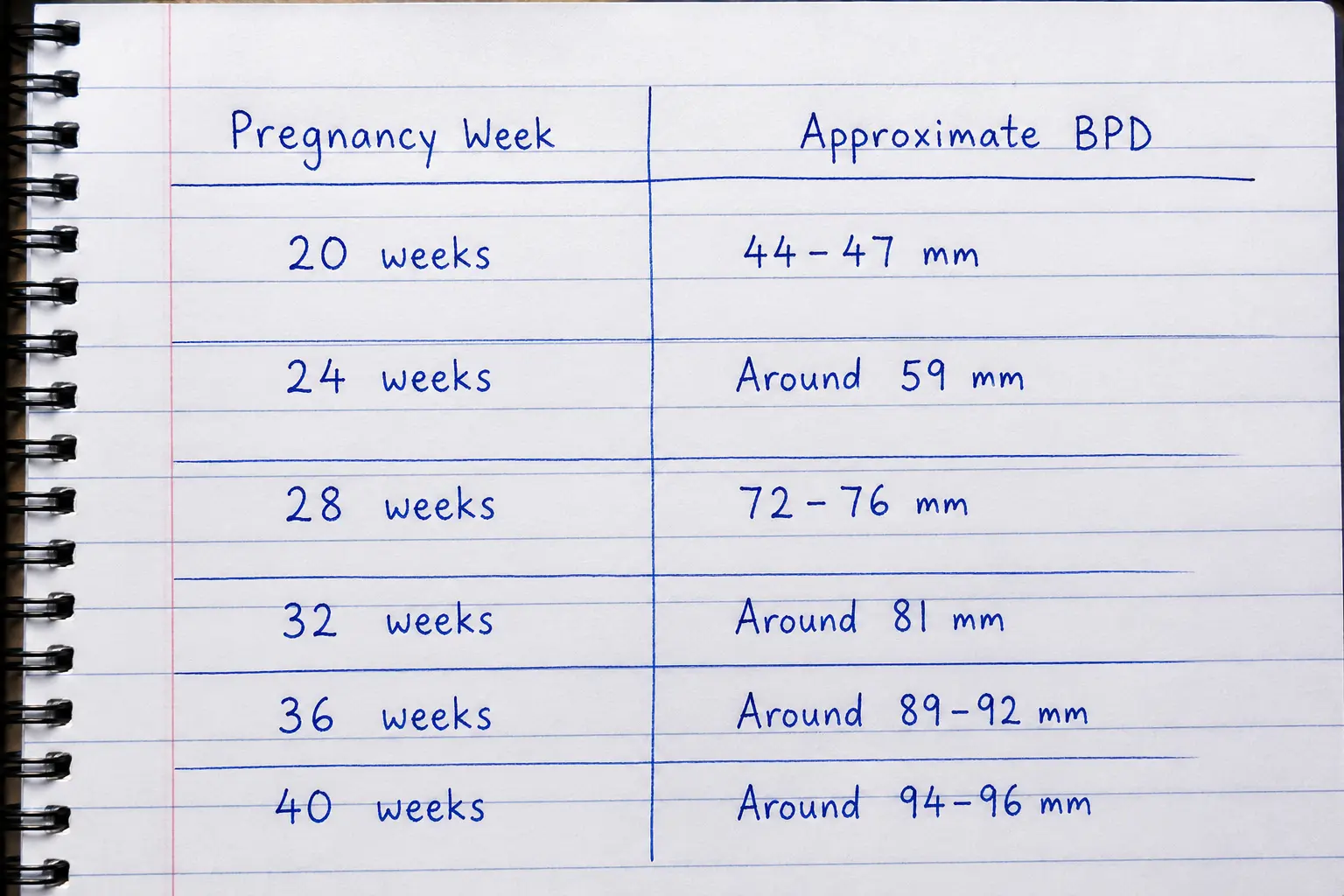
BPD increases as the baby grows, so there is no single normal BPD number for the entire pregnancy. The reference range also depends on the growth chart used by the ultrasound center.
| Pregnancy Week | Approximate BPD |
|---|---|
| 20 weeks | 44–47 mm |
| 24 weeks | Around 59 mm |
| 28 weeks | 72–76 mm |
| 32 weeks | Around 81 mm |
| 36 weeks | Around 89–92 mm |
| 40 weeks | Around 94–96 mm |
These are reference values, not diagnostic cut-offs. Your doctor will compare the measurement with the appropriate gestational-age chart and other fetal measurements.
What Does BPD Percentile Mean?
A BPD percentile shows how your baby’s head measurement compares with other babies at the same stage of pregnancy. A measurement that is not exactly average does not automatically mean something is wrong.
Doctors are more interested in the overall growth pattern, including HC, AC, FL and estimated fetal weight, than in one isolated number.
Can BPD Tell You How Much Your Baby Weighs?
BPD alone cannot accurately determine your baby’s weight. Estimated fetal weight is calculated using several ultrasound measurements, commonly including head and abdominal measurements and femur length. Even estimated fetal weight has a margin of error.
Can BPD Determine the Baby’s Due Date?
BPD can help estimate gestational age, particularly earlier in pregnancy. However, it should not be used alone to repeatedly change an established due date. Early pregnancy dating methods are generally more reliable for establishing gestational age.
What If BPD Is Low or High?
A low BPD may reflect a smaller head measurement, differences in head shape, incorrect dating, or a growth concern. A high BPD may simply reflect normal variation or a larger head size.
The important point is that one BPD value cannot diagnose a condition. Your doctor will look at the complete ultrasound picture and the baby’s growth over time.
Does BPD Tell the Baby’s Gender?
No. BPD measures the width of the baby’s head and cannot reliably determine whether the baby is a boy or girl.
When Should You Be Concerned About BPD?
Do not panic over a single ultrasound number. Ask your doctor for an explanation if your report shows a BPD significantly above or below the expected range, especially when other measurements are also outside the expected range.
A follow-up ultrasound may be recommended to monitor the baby’s growth and check whether the measurement remains on the same growth pattern.
Simple Takeaway
BPD is a measurement of your baby’s head width—not a diagnosis. A healthy pregnancy is assessed using BPD together with HC, AC, FL, estimated fetal weight, growth over time and other ultrasound findings.
How Mamata Fertility Hospital Hyderabad Ensures Accurate Fetal Monitoring
When it comes to pregnancy care, having the right team by your side is crucial. Mamata Fertility Hospital Hyderabad is renowned for delivering comprehensive maternity care and expert monitoring services.
Here’s what makes Mamata Fertility Hospital stand out:
- Advanced Ultrasound Technology: The hospital uses state-of-the-art ultrasound machines for precise and reliable fetal growth measurements.
- Experienced Specialists: Their dedicated team of obstetricians and sonographers ensures accurate diagnosis and tailored advice throughout your pregnancy.
- Compassionate Maternity Care: Mamata Fertility Hospital Hyderabad emphasizes holistic pregnancy care, from routine screenings to labor and delivery, ensuring a stress-free experience for mothers-to-be.
With their expertise, you can rest assured that your baby’s health and development are in safe hands.
Consult Mamata Fertility Hospital Hyderabad for Expert Pregnancy Care
At Mamata Fertility Hospital in Hyderabad, you and your baby’s well-being come first. With their expert team and advanced facilities, the hospital offers you the guidance and support you need for a smooth and healthy pregnancy. Whether it’s monitoring your baby’s BPD or offering personalized care, trust Mamata for unparalleled expertise and compassionate service.
Take the next step toward ensuring your baby’s healthy growth. Contact Mamata Fertility Hospital Hyderabad today to schedule an ultrasound or consultation with their skilled specialists.
FAQ
What is BPD in pregnancy?
BPD means biparietal diameter. It is the ultrasound measurement of the width of the baby’s head.
BPD means biparietal diameter. It is the ultrasound measurement of the width of the baby's head.
BPD at 20 weeks is commonly around 44–47 mm, but the expected range varies by growth chart and individual pregnancy.
What is a normal BPD at 28 weeks?
At 28 weeks, BPD is commonly around 72–76 mm, although the appropriate reference range depends on the chart used.
What is a normal BPD at 32 weeks?
BPD at 32 weeks is approximately 81 mm in commonly used reference charts, but your doctor will interpret it according to gestational age and other measurements.
What does low BPD mean in pregnancy?
Low BPD means the baby’s head width is smaller than expected for that gestational age. It may be normal variation or may require further assessment with other measurements.
What does high BPD mean in pregnancy?
High BPD means the baby’s head width is larger than expected for gestational age. It does not automatically indicate a health problem.
Is BPD more important than HC in pregnancy?
No. BPD and HC provide different information about the fetal head, and doctors interpret them together with AC, FL and other ultrasound findings.
Can BPD predict baby weight?
BPD alone cannot accurately predict fetal weight. Several ultrasound measurements are used to estimate fetal weight.
Can BPD predict baby gender?
No. BPD cannot reliably predict the baby’s gender.
Does BPD change every week?
Yes. The baby’s head grows throughout pregnancy, so BPD normally increases with gestational age.
Can BPD be wrong on an ultrasound?
Yes. Fetal position, head shape, image quality, measurement technique and gestational-age dating can affect BPD results.
Is BPD important in the third trimester?
Yes. BPD can still be part of fetal biometry, but doctors consider head shape and other measurements when assessing growth, particularly later in pregnancy.
What should I do if my baby's BPD is smaller than expected?
Discuss the result with your obstetrician. Your doctor may compare BPD with HC, AC, FL and estimated fetal weight and may recommend follow-up ultrasound if needed.
Is a BPD of 90 mm normal at 36 weeks?
A BPD around 90 mm can fall within commonly reported reference values at 36 weeks, but the exact interpretation depends on the growth chart and the baby’s other measurements.
Does BPD indicate brain development?
BPD measures head width. It is one component of fetal biometry and should not be used by itself to assess brain development.

Dr Aarti Deenadayal Tolani
MBBS, MS ( OBGYN), FICOG
Clinical Director, Scientific In- Charge & Fertility Consultant with 20+ years Of Experience
Her Expertise:
CONSULT FERTILITY SPECIALIST

LATEST BLOGS

How to Read and Interpret a Semen Analysis Test Report?
Learn how to read and interpret a semen analysis report, including sperm count, motility, morphology, semen volume, vitality, Total Motile Count, and WHO 2021 reference values.

How to Choose an IVF Clinic: A Patient’s Checklist
Choosing an IVF clinic? Use this patient checklist to compare diagnosis, ART registration, success rates, costs, treatment teams, add-ons and support.

Understanding Sperm DNA Fragmentation Test and IVF Success
Understand sperm DNA fragmentation testing, DFI levels, causes of high sperm DNA damage, and how SDF can affect IVF, ICSI, embryo quality and miscarriage risk.

Oligospermia Treatment: Low Sperm Count & Pregnancy Options
Oligospermia means a low sperm count. Learn its causes, diagnosis, treatment options, IUI, IVF with ICSI, and chances of conception.
